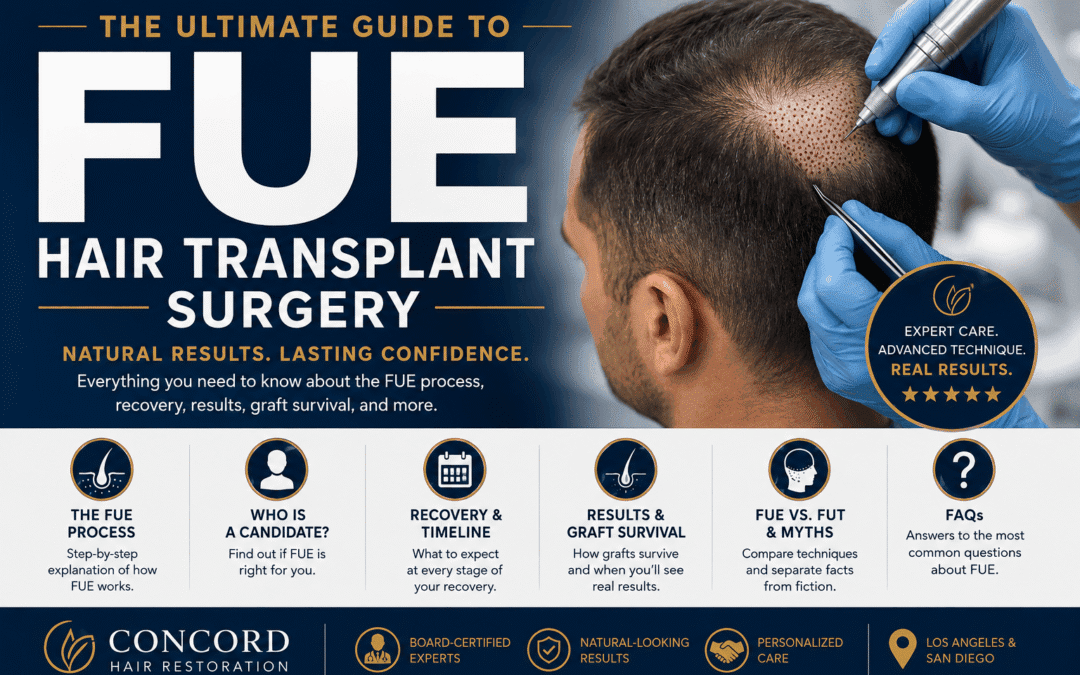
Everything to Know About the Procedure, Recovery, Results, Graft Survival, and Donor Hair
Hair restoration has changed considerably over the years.
Older procedures often relied on large grafts or strip harvesting techniques that could produce visible scarring or results that were easier to detect. Modern Follicular Unit Extraction, commonly called FUE, takes a more precise approach by removing and transplanting naturally occurring follicular units individually.
When FUE is properly planned and performed, the goal is not simply to add more hair. The goal is to create a natural hairline, improve coverage, preserve the donor area, and produce a result that continues to look appropriate as the patient ages.
This guide explains:
- What an FUE hair transplant is
- How the procedure works
- Who may be a good candidate
- Why donor-area planning matters
- How transplanted grafts survive
- What recovery looks like
- When new growth typically appears
- How FUE compares with FUT
- Common risks and misconceptions
- What to ask during a consultation
Patients researching treatment in Southern California can also explore Concord Hair Restoration’s dedicated Hair Transplant Los Angeles page or learn about care available through our San Diego Hair Restoration location.
Quick Answer: What Is an FUE Hair Transplant?
Follicular Unit Extraction is a surgical hair-restoration technique in which naturally occurring groups of one to four hairs are removed individually from a donor area and transplanted into areas affected by thinning or hair loss.
The donor area is usually located along the back and sides of the scalp, where follicles tend to be more resistant to the hormonal effects associated with androgenetic alopecia. Unlike FUT, FUE does not require removing a linear strip of scalp, so it avoids a single linear donor scar. It does, however, create many tiny circular extraction sites that must be distributed carefully throughout the donor region.
The success of the procedure depends on much more than the extraction technology. Candidate selection, hairline design, donor management, graft handling, recipient-site creation, and postoperative care all influence the outcome.
What Does FUE Stand For?
FUE is commonly described as either:
- Follicular Unit Extraction, referring to the removal of individual follicular units
- Follicular Unit Excision, a term that more precisely describes the small circular incision used to release each unit
A follicular unit is a natural grouping that can contain one, two, three, or sometimes four hairs, along with supporting structures such as a sebaceous gland and arrector pili muscle. Transplanting intact follicular units allows a physician to recreate natural growth patterns more effectively than older plug-style procedures.
For a more focused explanation, read What Is Follicular Unit Extraction?.
How Does an FUE Hair Transplant Work?
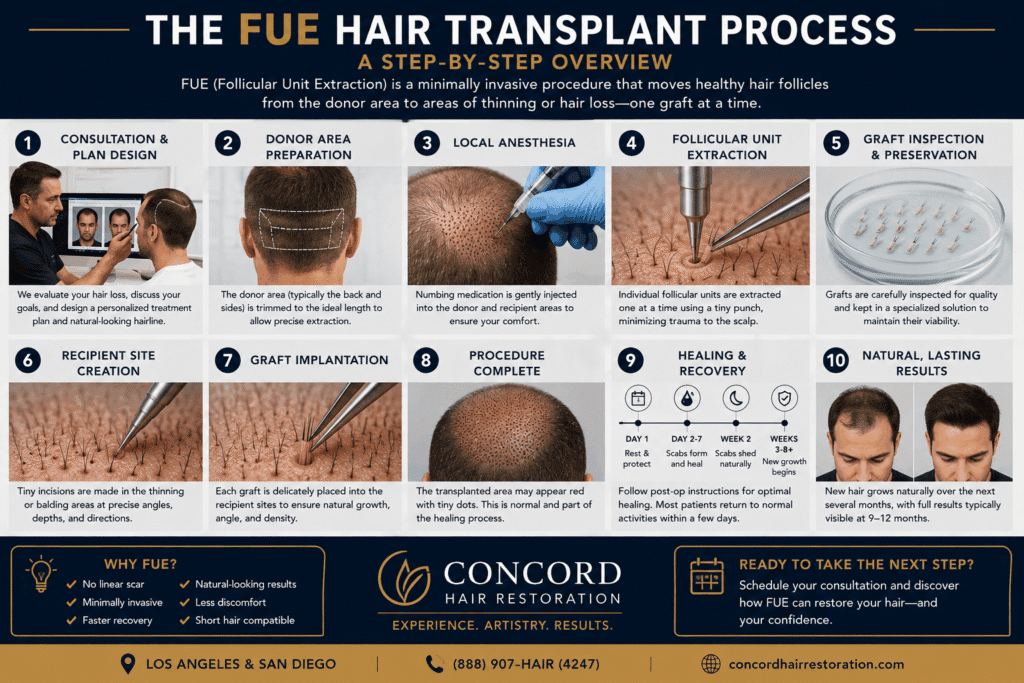
Although each treatment plan is individualized, an FUE procedure generally involves several important stages.
1. Consultation and Hair-Loss Evaluation
The process begins with an evaluation of the patient’s hair loss, donor supply, scalp health, medical history, goals, and likelihood of future progression.
The consultation may include an assessment of:
- Hairline recession
- Crown thinning
- Mid-scalp density
- Donor density
- Hair caliber
- Hair texture and curl pattern
- Skin-to-hair color contrast
- Areas of miniaturization
- Previous procedures
- Family history
- Expectations for coverage and density
The physician must also determine whether the hair loss appears stable enough for surgery and whether it represents a condition that can be treated safely with transplantation.
Patients with active inflammatory or scarring forms of alopecia may require further evaluation or treatment before transplantation is considered. Ideal candidates generally have a healthy scalp, a definable pattern of hair loss, suitable donor density, and realistic expectations.
2. Personalized Hairline Design
Hairline design is one of the most important parts of the procedure.
A natural hairline is not perfectly straight, perfectly symmetrical, or uniformly dense. It usually contains subtle irregularities, finer single-hair grafts near the front, and a gradual transition into greater density behind the leading edge.
The design should consider:
- Facial proportions
- Forehead height
- Age
- Sex
- Existing temple points
- Native hair direction
- Ethnic hair characteristics
- Future hair loss
- Available donor supply
- Preferred hairstyles
An aggressively low hairline may look attractive immediately but become increasingly difficult to support if native hair continues thinning. Conservative, age-appropriate planning often produces a more natural long-term result.
Learn why this matters in Why Natural Hairlines Matter More Than Hair Count.
3. Donor-Area Planning
Before extracting grafts, the physician identifies the safest and most useful donor region.
Most scalp grafts are taken from the back and sides of the head. These follicles tend to retain the characteristics of their original donor location after they are moved.
However, the donor area is not unlimited.
Removing too many follicular units or concentrating extractions in a small region can leave visible thinning, patchiness, or a depleted appearance. For this reason, extractions should be distributed carefully and planned with the patient’s potential future needs in mind.
The donor area is one of the main limiting factors in any hair transplant, regardless of technique.
Read more about Donor Area Management and Overharvesting and What Happens to Your Donor Area Years After a Hair Transplant.
4. Trimming or Shaving the Donor Hair
In many FUE procedures, donor hair is trimmed short so the physician can identify the direction and angle of each follicular unit.
The amount of shaving required varies according to:
- The extraction method
- The number of grafts
- Hair length
- Donor density
- Patient preferences
- Whether a partial-shave or no-shave approach is appropriate
Not every patient requires the same preparation. This should be discussed before the procedure.
5. Local Anesthesia
FUE is generally performed using local anesthesia.
The donor and recipient areas are numbed so the patient should not feel the individual extraction or placement of each graft. Patients may still notice pressure, vibration, pulling, or brief discomfort during anesthetic injections.
For a more complete discussion, visit Does a Hair Transplant Hurt?.
6. Individual Graft Extraction
A small punch is aligned with the direction of each follicular unit. The punch enters the skin around the unit, releasing it from the surrounding tissue so it can be removed carefully.
Depending on the clinic and treatment plan, extraction may be:
- Manual
- Motorized
- Robotic-assisted
- Supported by systems such as NeoGraft
Punch dimensions and technique should be adjusted to the patient’s skin, hair angle, curl pattern, and follicular anatomy. Curved follicles, including many Afro-textured follicles, require specialized planning because the visible direction above the skin does not always reveal the full curve beneath it.
Learn about this technology on the NeoGraft Hair Transplant service page.
7. Graft Inspection and Preservation
Once removed, follicular units are inspected, organized, and placed in an appropriate holding solution until implantation.
This stage is extremely important.
Grafts are living tissue. They must be handled gently and protected from:
- Drying
- Crushing
- Excessive manipulation
- Prolonged time outside the body
- Inappropriate temperatures
- Transection during extraction
Modern graft-survival recommendations address the entire process, including preoperative preparation, harvesting, trimming, storage, implantation, postoperative care, and complication prevention.
8. Recipient-Site Creation
The physician creates small recipient sites in the thinning area.
The angle, direction, spacing, and depth of these sites influence how the new hair will eventually grow.
For example:
- Frontal hairs usually emerge at a relatively acute angle.
- Temple hairs require precise direction and often lie close to the skin.
- Crown grafts must follow the patient’s natural whorl.
- Single-hair grafts are generally used near the front.
- Multi-hair grafts can be placed behind the transition zone to build visual density.
Creating recipient sites is not simply a technical step. It is where much of the artistic planning becomes physically established.
9. Graft Placement
The follicular units are then placed into the prepared recipient sites.
Placement must avoid damaging the bulb or other structures necessary for growth. Grafts should also remain hydrated and be positioned at the appropriate depth.
The number of grafts used in each region depends on the patient’s goals, donor limitations, hair caliber, existing native density, and long-term plan.
Read How Many Grafts Do I Need? for a deeper explanation.
What Makes Someone a Good Candidate for FUE?
FUE may be appropriate for men and women with suitable donor hair and a pattern of loss that can be improved through transplantation.
A favorable candidate may have:
- Male pattern hair loss
- Female pattern thinning that is suitable for surgery
- A receding frontal hairline
- Temple recession
- Crown thinning
- Traction alopecia that is no longer active
- Hair loss from a stable scar
- Patchy beard growth
- Eyebrow loss
- Adequate donor density
- Healthy scalp tissue
- Realistic expectations
- A willingness to follow postoperative instructions
Candidate selection cannot be based on age or Norwood stage alone. Two patients with similar visible hair loss may have very different donor density, follicular miniaturization, future risk, and treatment options.
Hair transplantation is most suitable when the physician can create a meaningful improvement without exhausting the available donor supply.
Patients uncertain about their pattern of loss can begin with the Norwood Scale and Hair Transplant Candidacy Guide.
Who May Not Be Ready for an FUE Hair Transplant?
FUE is not automatically the best option for everyone who is losing hair.
A patient may need to delay surgery or consider another approach when there is:
- Active scarring alopecia
- Uncontrolled scalp inflammation
- Unexplained diffuse shedding
- Insufficient donor density
- Rapidly progressing hair loss in a very young patient
- Unrealistic expectations
- A medical condition that makes elective surgery unsafe
- An expectation of teenage-level density across an extensive bald area
- Body dysmorphic concerns
- Poor willingness to follow postoperative instructions
Some patients may benefit from medical management or observation before surgery.
Hair transplantation relocates follicles, but it does not cure the underlying tendency for untreated native hair to thin. Continued progression can create gaps between transplanted and native areas if the procedure is not planned conservatively.
Read What Happens if You Continue Losing Hair After a Hair Transplant?.
Why the Donor Area Matters So Much
Patients often focus on the recipient area because that is where they want to see new hair. From a long-term planning perspective, however, the donor area may be even more important.
Donor hair is a limited biological resource.
The physician must decide:
- Which follicles can be harvested safely
- How widely extractions should be distributed
- How much donor density should remain
- Whether the patient may need another procedure later
- Whether the donor region itself shows miniaturization
- How hair length and styling may reveal extraction sites
- Whether beard or body hair should ever be considered as a secondary source
FUE does not make donor hair unlimited.
Removing individual follicles without a linear scar is an advantage, but overharvesting can still create a visibly thinned donor region. Good FUE planning seeks to improve the recipient area without making the back or sides of the scalp look depleted.
Can Donor Hair Grow Back After Extraction?
The follicles removed during FUE are transferred to another location. The original extraction sites generally do not regenerate replacement follicles.
Surrounding donor hair can camouflage the tiny extraction points when harvesting is appropriately spaced and density remains sufficient.
This is why responsible donor management is fundamental to natural, long-lasting results.
How Do FUE Grafts Survive?
A transplanted graft must survive extraction, storage, implantation, and the early healing period.
Immediately after implantation, the graft is separated from its original blood supply. During the first stage of healing, it receives nutrients from the surrounding tissue. New vascular connections then develop between the graft and the recipient area.
Several factors can influence graft survival:
- Minimizing follicle transection
- Gentle extraction
- Proper hydration
- Appropriate storage conditions
- Limited time outside the body
- Correct recipient-site depth
- Careful implantation
- Adequate blood supply
- Avoiding smoking when instructed
- Protecting grafts from trauma
- Following postoperative care instructions
The visible hair shaft may shed several weeks after surgery even when the follicle remains alive. Shedding is therefore not the same as graft failure.
What Is Graft Transection?
Transection occurs when part of the follicular unit is cut or damaged during extraction.
Because the lower portion of a follicle curves beneath the skin, the punch must follow its direction carefully. The risk can vary with hair type, skin characteristics, punch design, and operator technique.
Experienced extraction and appropriate equipment help reduce avoidable damage.
Does Every Graft Survive?
No surgical practice can honestly guarantee that every transplanted follicle will grow.
Some grafts may be damaged during harvesting or implantation, fail to establish a sufficient blood supply, or be affected by patient-specific healing factors. Hair-transplant risks can include graft failure, infection, scarring, bleeding, shock loss, and an unnatural or patchy appearance, although the overall procedure is generally considered safe when performed by qualified and experienced professionals.
For additional context, read Can a Hair Transplant Fail? and Hair Transplant Results.
What Happens Immediately After FUE?
After the procedure, patients usually see tiny recipient sites where the grafts were placed and small extraction points within the donor area.
Common early changes may include:
- Redness
- Mild swelling
- Scabbing or crusting
- Temporary tenderness
- Tightness
- Itching
- Short transplanted hair shafts
- Small dots within the donor area
The exact instructions differ among patients and practices. Patients should follow the specific washing, sleeping, medication, and activity directions provided by their clinical team rather than relying on generalized online advice.
FUE Recovery Timeline
Day 1
The grafts have been placed, and the initial healing process begins.
Patients are generally instructed to protect the recipient area from rubbing, scratching, pressure, and accidental contact.
Days 2–3
Mild swelling, redness, and crusting may become more noticeable.
The donor region begins closing, while the recipient area remains delicate.
Days 4–7
Small scabs are usually visible.
Itching may develop as the skin heals, but patients should avoid picking at the crusts or scratching the recipient area.
Week 2
Many patients look considerably more normal by the second week.
Most scabs have loosened or fallen away according to the clinic’s washing instructions, although residual pinkness may remain.
Weeks 3–8
Many of the visible transplanted hairs shed.
This can alarm patients, but the follicle may remain alive beneath the skin and enter a resting phase before producing a new shaft.
Temporary shock loss can also affect nearby native hair or, less commonly, donor-region hair.
Months 3–4
New hairs may begin emerging.
Early growth can appear:
- Fine
- Uneven
- Light in color
- Wiry or soft
- Sparse compared with the eventual result
Month 6
Many patients notice meaningful cosmetic improvement around the six-month point, although density and maturity are not complete.
Months 7–9
Hair shafts continue thickening, lengthening, and becoming easier to style.
Months 10–12
Many frontal results are substantially developed by approximately one year.
The crown may mature more slowly, and some patients continue noticing improvements beyond 12 months.
For a detailed milestone guide, visit the Hair Transplant Recovery Timeline and Hair Transplant Recovery Timeline in Los Angeles.
When Can You Return to Work?
The answer depends on the patient’s job, procedure size, hairstyle, comfort level, and willingness to be seen with redness or short hair.
Some patients with desk jobs return after several days. Others prefer taking a week or longer so visible scabbing and swelling have more time to settle.
Physically demanding work may require a longer pause because sweating, friction, pressure, and strenuous movement can affect early recovery instructions.
Your clinic should provide guidance based on your procedure and occupation.
When Can You Exercise After FUE?
Exercise restrictions depend on the procedure and physician instructions.
Strenuous exercise may temporarily increase swelling, sweating, blood pressure, or the risk of accidental contact with the scalp. Patients are commonly advised to avoid intense activity during early healing and then resume gradually.
Contact sports require additional caution because direct impact could injure the recipient or donor area.
Follow your own postoperative instructions rather than a fixed online timeline.
When Do FUE Results Become Visible?
FUE results develop gradually.
The procedure does not produce a complete head of long hair immediately. Transplanted shafts commonly shed before new growth appears.
A typical pattern is:
- First two weeks: Healing and crusting
- First two months: Shedding and a relatively quiet appearance
- Months three to four: Early new growth
- Around month six: Noticeable improvement
- Months nine to twelve: Increased maturity and density
- Beyond one year: Continued refinement for some patients, especially in the crown
Hair growth is biological, not instantaneous.
Comparing daily photographs often creates unnecessary anxiety because change is gradual. Monthly images taken under consistent lighting and angles are usually more useful.
Review real outcomes in the Hair Restoration Case Studies, Gallery of Hair Transplant Results, and Before and After Hair Transplant resources.
What Creates Natural-Looking FUE Results?
The extraction method is only one part of a successful procedure.
Natural results depend on several connected decisions.
Hairline Shape
The hairline should complement the patient’s face and age rather than copy a generic template.
Appropriate Use of Single-Hair Grafts
Single-hair grafts near the leading edge can create a softer transition.
Placing large multi-hair units directly at the front may look coarse or unnatural.
Direction and Angle
Grafts must follow natural growth patterns.
Even dense growth can look artificial if hairs point in the wrong direction or emerge too vertically.
Density Distribution
Not every region requires identical density.
Strategic distribution can create the appearance of greater coverage while conserving donor hair.
Donor Preservation
A result cannot be considered successful if the recipient area improves while the donor area becomes noticeably depleted.
Long-Term Planning
The procedure should anticipate the possibility that native hair may continue thinning.
Hair Characteristics
Thick, curly, or low-contrast hair can create greater visual coverage per graft than very fine, straight hair with high contrast against the scalp.
Read Hair Transplant Density Explained and Why Some Hair Transplants Look Unnatural.
Does More Grafts Always Mean Better Results?
No.
Graft count is important, but it is not the only measure of quality.
An unnecessarily high number can:
- Deplete donor reserves
- Increase procedural time
- Place too much demand on a limited recipient area
- Reduce options for future surgery
- Create unrealistic expectations
- Distract from hairline artistry and distribution
A carefully designed procedure with fewer strategically placed grafts may produce a better cosmetic result than a poorly planned procedure using more grafts.
The number should be based on:
- Treatment area
- Desired density
- Donor supply
- Hair caliber
- Curl
- Existing native hair
- Future progression
- Patient priorities
See Why Hair Density Is More Important Than Hair Count and How Many Grafts for a Hair Transplant in Los Angeles?.
FUE Versus FUT
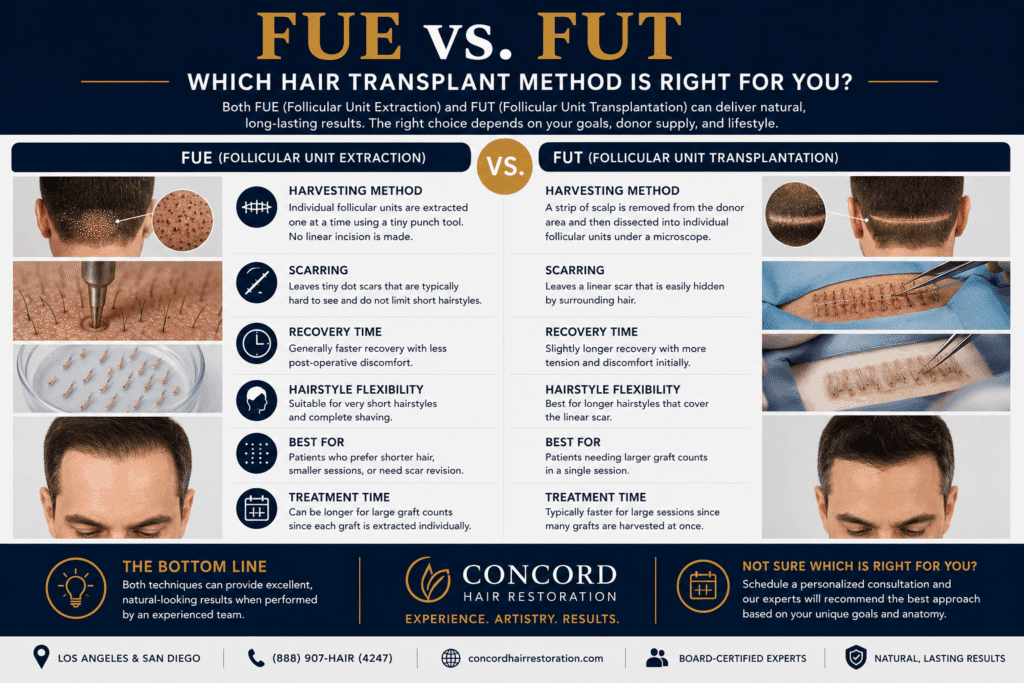
FUE and FUT both transplant follicular units, but they harvest them differently.
FUE
FUE removes follicular units individually with small punches.
Potential advantages may include:
- No single linear donor scar
- Greater flexibility with shorter hairstyles
- Smaller distributed extraction sites
- Reduced healing time for many patients
- Less postoperative discomfort in many cases
- Ability to select individual follicular units
Potential limitations include:
- Risk of overharvesting
- Longer extraction time in some procedures
- Technical difficulty with curved follicles
- Need to trim or shave donor hair in many cases
- Numerous small scars rather than no scarring at all
- Donor supply still remains limited
FUT
FUT removes a strip of donor scalp that is then dissected into follicular units.
Potential advantages may include:
- Efficient harvesting of many grafts
- Preservation of surrounding donor regions for future procedures
- Less need to shave a broad donor area in some cases
- Suitability for certain patients needing larger sessions
Potential limitations include:
- A linear donor scar
- Longer incision healing
- Greater tightness or discomfort for some patients
- Reduced flexibility with very short hairstyles
FUE is often selected by patients who prefer shorter hairstyles or wish to avoid a linear scar, but FUT may remain appropriate in selected cases. The best technique depends on scalp laxity, donor density, hairstyle, graft requirements, surgical history, and long-term planning.
Read the full comparison at FUE Versus FUT.
Does FUE Leave Scars?
FUE does not create the long linear scar associated with strip harvesting.
However, that does not mean it is scar-free.
Each extraction produces a tiny circular wound that heals as a small dot. These points are often difficult to see when harvesting is performed carefully and sufficient surrounding density remains, but visibility can vary according to:
- Punch size
- Skin type
- Healing response
- Number of extractions
- Extraction pattern
- Hair length
- Donor density
- Previous procedures
- Tendency toward abnormal scarring
The accurate claim is that FUE avoids a linear donor scar, not that it creates no scars whatsoever.
Learn more in Do Hair Transplants Leave Scars?.
Potential FUE Risks and Side Effects
Hair transplantation is elective surgery, and no procedure is risk-free.
Possible risks or temporary effects include:
- Redness
- Swelling
- Bleeding
- Infection
- Folliculitis
- Itching
- Numbness
- Temporary shock loss
- Visible scarring
- Uneven growth
- Graft failure
- Overharvesting
- Poor density
- An unnatural hairline
- Cysts or ingrown hairs
- Need for additional treatment
Hair loss can also continue in untreated native areas after surgery, potentially creating an uneven appearance if the original plan did not account for future progression.
Review Hair Restoration Risks and discuss your individual health history during a consultation.
Common FUE Myths
Myth 1: FUE Is Completely Scarless
FUE avoids a long linear scar, but every extracted follicular unit leaves a small healing site.
Myth 2: Every Transplanted Graft Is Guaranteed to Grow
No ethical clinic can guarantee 100% growth. Graft survival depends on surgical technique, handling, recipient blood supply, healing, and patient factors.
Myth 3: FUE Stops Future Hair Loss
FUE moves follicles into thinning areas. It does not stop untreated native follicles from continuing to miniaturize.
Myth 4: The Highest Graft Count Produces the Best Result
Distribution, hairline design, angle, donor conservation, and hair characteristics can matter as much as the total count.
Myth 5: FUE Results Are Immediate
The initial shafts commonly shed. New visible growth usually takes several months.
Myth 6: Anyone With Hair Loss Is a Candidate
Some patients have inadequate donor supply, active scalp disease, unstable loss, or expectations that cannot be met safely.
Myth 7: Technology Performs the Entire Procedure
Devices can assist with harvesting, but medical judgment, design, donor planning, recipient-site creation, and supervision remain essential.
Myth 8: A Hair Transplant Can Restore Unlimited Density
Donor follicles are finite. The objective is meaningful cosmetic coverage, not unlimited replacement of every lost hair.
How Much Does an FUE Hair Transplant Cost?
FUE pricing varies because each plan is customized.
Factors may include:
- Number of grafts
- Size of the treatment area
- Donor density
- Procedure complexity
- Hair texture
- Previous surgery
- Scar repair
- Time required
- Technology used
- Experience of the clinical team
- Follow-up care
- Geographic market
Choosing based only on the lowest price can overlook important issues such as donor preservation, physician involvement, hairline design, graft handling, and continuity of care.
Read the Hair Transplant Cost Guide, learn about Hair Transplant Cost in Los Angeles, or review available Payment Plans and Financing Options.
How to Choose an FUE Clinic
During your research, look beyond advertising language and graft-price promotions.
Ask about:
- Who evaluates candidacy
- Who designs the hairline
- Who performs the extractions
- Who creates recipient sites
- Who places grafts
- How the donor area is measured
- How overharvesting is prevented
- How grafts are stored
- How the team manages curved or textured follicles
- How many patients are treated each day
- What happens if growth is lower than expected
- Whether long-term hair loss is discussed
- Whether before-and-after photos use consistent angles and lighting
- What postoperative support is provided
An informative consultation should include honest discussion of limitations, alternatives, donor supply, and future hair loss.
Use our Guide to Choosing an FUE Hair Clinic in Los Angeles and learn How to Choose the Best Hair Transplant Surgeon in Los Angeles.
Frequently Asked Questions About FUE Hair Transplants
Worked for 53s
I used your current sitemap to select internal links that support the new pillar page without sending every reader back to the homepage. Your site already has dedicated resources covering donor management, graft counts, FUE versus FUT, results, scarring, natural hairlines, procedure steps, and Los Angeles recovery, so this guide can operate as the central hub connecting them.
SEO Details
Suggested URL:https://concordhairrestoration.com/fue-hair-transplant-guide/
Meta title:
Ultimate Guide to FUE Hair Transplant Surgery | Concord
Meta description:
Learn how FUE hair transplant surgery works, who qualifies, what recovery involves, how grafts survive, and what creates natural, lasting results.
The Ultimate Guide to FUE Hair Transplant Surgery
Everything to Know About the Procedure, Recovery, Results, Graft Survival, and Donor Hair
Hair restoration has changed considerably over the years.
Older procedures often relied on large grafts or strip harvesting techniques that could produce visible scarring or results that were easier to detect. Modern Follicular Unit Extraction, commonly called FUE, takes a more precise approach by removing and transplanting naturally occurring follicular units individually.
When FUE is properly planned and performed, the goal is not simply to add more hair. The goal is to create a natural hairline, improve coverage, preserve the donor area, and produce a result that continues to look appropriate as the patient ages.
This guide explains:
- What an FUE hair transplant is
- How the procedure works
- Who may be a good candidate
- Why donor-area planning matters
- How transplanted grafts survive
- What recovery looks like
- When new growth typically appears
- How FUE compares with FUT
- Common risks and misconceptions
- What to ask during a consultation
Patients researching treatment in Southern California can also explore Concord Hair Restoration’s dedicated Hair Transplant Los Angeles page or learn about care available through our San Diego Hair Restoration location.
Quick Answer: What Is an FUE Hair Transplant?
Follicular Unit Extraction is a surgical hair-restoration technique in which naturally occurring groups of one to four hairs are removed individually from a donor area and transplanted into areas affected by thinning or hair loss.
The donor area is usually located along the back and sides of the scalp, where follicles tend to be more resistant to the hormonal effects associated with androgenetic alopecia. Unlike FUT, FUE does not require removing a linear strip of scalp, so it avoids a single linear donor scar. It does, however, create many tiny circular extraction sites that must be distributed carefully throughout the donor region.
The success of the procedure depends on much more than the extraction technology. Candidate selection, hairline design, donor management, graft handling, recipient-site creation, and postoperative care all influence the outcome.
What Does FUE Stand For?
FUE is commonly described as either:
- Follicular Unit Extraction, referring to the removal of individual follicular units
- Follicular Unit Excision, a term that more precisely describes the small circular incision used to release each unit
A follicular unit is a natural grouping that can contain one, two, three, or sometimes four hairs, along with supporting structures such as a sebaceous gland and arrector pili muscle. Transplanting intact follicular units allows a physician to recreate natural growth patterns more effectively than older plug-style procedures.
For a more focused explanation, read What Is Follicular Unit Extraction?.
How Does an FUE Hair Transplant Work?
Although each treatment plan is individualized, an FUE procedure generally involves several important stages.
1. Consultation and Hair-Loss Evaluation
The process begins with an evaluation of the patient’s hair loss, donor supply, scalp health, medical history, goals, and likelihood of future progression.
The consultation may include an assessment of:
- Hairline recession
- Crown thinning
- Mid-scalp density
- Donor density
- Hair caliber
- Hair texture and curl pattern
- Skin-to-hair color contrast
- Areas of miniaturization
- Previous procedures
- Family history
- Expectations for coverage and density
The physician must also determine whether the hair loss appears stable enough for surgery and whether it represents a condition that can be treated safely with transplantation.
Patients with active inflammatory or scarring forms of alopecia may require further evaluation or treatment before transplantation is considered. Ideal candidates generally have a healthy scalp, a definable pattern of hair loss, suitable donor density, and realistic expectations.
You can prepare for this appointment using our guide to Hair Transplant Consultation Questions.
2. Personalized Hairline Design
Hairline design is one of the most important parts of the procedure.
A natural hairline is not perfectly straight, perfectly symmetrical, or uniformly dense. It usually contains subtle irregularities, finer single-hair grafts near the front, and a gradual transition into greater density behind the leading edge.
The design should consider:
- Facial proportions
- Forehead height
- Age
- Sex
- Existing temple points
- Native hair direction
- Ethnic hair characteristics
- Future hair loss
- Available donor supply
- Preferred hairstyles
An aggressively low hairline may look attractive immediately but become increasingly difficult to support if native hair continues thinning. Conservative, age-appropriate planning often produces a more natural long-term result.
Learn why this matters in Why Natural Hairlines Matter More Than Hair Count.
3. Donor-Area Planning
Before extracting grafts, the physician identifies the safest and most useful donor region.
Most scalp grafts are taken from the back and sides of the head. These follicles tend to retain the characteristics of their original donor location after they are moved.
However, the donor area is not unlimited.
Removing too many follicular units or concentrating extractions in a small region can leave visible thinning, patchiness, or a depleted appearance. For this reason, extractions should be distributed carefully and planned with the patient’s potential future needs in mind.
The donor area is one of the main limiting factors in any hair transplant, regardless of technique.
Read more about Donor Area Management and Overharvesting and What Happens to Your Donor Area Years After a Hair Transplant.
4. Trimming or Shaving the Donor Hair
In many FUE procedures, donor hair is trimmed short so the physician can identify the direction and angle of each follicular unit.
The amount of shaving required varies according to:
- The extraction method
- The number of grafts
- Hair length
- Donor density
- Patient preferences
- Whether a partial-shave or no-shave approach is appropriate
Not every patient requires the same preparation. This should be discussed before the procedure.
5. Local Anesthesia
FUE is generally performed using local anesthesia.
The donor and recipient areas are numbed so the patient should not feel the individual extraction or placement of each graft. Patients may still notice pressure, vibration, pulling, or brief discomfort during anesthetic injections.
For a more complete discussion, visit Does a Hair Transplant Hurt?.
6. Individual Graft Extraction
A small punch is aligned with the direction of each follicular unit. The punch enters the skin around the unit, releasing it from the surrounding tissue so it can be removed carefully.
Depending on the clinic and treatment plan, extraction may be:
- Manual
- Motorized
- Robotic-assisted
- Supported by systems such as NeoGraft
Punch dimensions and technique should be adjusted to the patient’s skin, hair angle, curl pattern, and follicular anatomy. Curved follicles, including many Afro-textured follicles, require specialized planning because the visible direction above the skin does not always reveal the full curve beneath it.
Learn about this technology on the NeoGraft Hair Transplant service page.
7. Graft Inspection and Preservation
Once removed, follicular units are inspected, organized, and placed in an appropriate holding solution until implantation.
This stage is extremely important.
Grafts are living tissue. They must be handled gently and protected from:
- Drying
- Crushing
- Excessive manipulation
- Prolonged time outside the body
- Inappropriate temperatures
- Transection during extraction
Modern graft-survival recommendations address the entire process, including preoperative preparation, harvesting, trimming, storage, implantation, postoperative care, and complication prevention.
8. Recipient-Site Creation
The physician creates small recipient sites in the thinning area.
The angle, direction, spacing, and depth of these sites influence how the new hair will eventually grow.
For example:
- Frontal hairs usually emerge at a relatively acute angle.
- Temple hairs require precise direction and often lie close to the skin.
- Crown grafts must follow the patient’s natural whorl.
- Single-hair grafts are generally used near the front.
- Multi-hair grafts can be placed behind the transition zone to build visual density.
Creating recipient sites is not simply a technical step. It is where much of the artistic planning becomes physically established.
9. Graft Placement
The follicular units are then placed into the prepared recipient sites.
Placement must avoid damaging the bulb or other structures necessary for growth. Grafts should also remain hydrated and be positioned at the appropriate depth.
The number of grafts used in each region depends on the patient’s goals, donor limitations, hair caliber, existing native density, and long-term plan.
Read How Many Grafts Do I Need? for a deeper explanation.
What Makes Someone a Good Candidate for FUE?
FUE may be appropriate for men and women with suitable donor hair and a pattern of loss that can be improved through transplantation.
A favorable candidate may have:
- Male pattern hair loss
- Female pattern thinning that is suitable for surgery
- A receding frontal hairline
- Temple recession
- Crown thinning
- Traction alopecia that is no longer active
- Hair loss from a stable scar
- Patchy beard growth
- Eyebrow loss
- Adequate donor density
- Healthy scalp tissue
- Realistic expectations
- A willingness to follow postoperative instructions
Candidate selection cannot be based on age or Norwood stage alone. Two patients with similar visible hair loss may have very different donor density, follicular miniaturization, future risk, and treatment options.
Hair transplantation is most suitable when the physician can create a meaningful improvement without exhausting the available donor supply.
Patients uncertain about their pattern of loss can begin with the Norwood Scale and Hair Transplant Candidacy Guide.
Who May Not Be Ready for an FUE Hair Transplant?
FUE is not automatically the best option for everyone who is losing hair.
A patient may need to delay surgery or consider another approach when there is:
- Active scarring alopecia
- Uncontrolled scalp inflammation
- Unexplained diffuse shedding
- Insufficient donor density
- Rapidly progressing hair loss in a very young patient
- Unrealistic expectations
- A medical condition that makes elective surgery unsafe
- An expectation of teenage-level density across an extensive bald area
- Body dysmorphic concerns
- Poor willingness to follow postoperative instructions
Some patients may benefit from medical management or observation before surgery.
Hair transplantation relocates follicles, but it does not cure the underlying tendency for untreated native hair to thin. Continued progression can create gaps between transplanted and native areas if the procedure is not planned conservatively.
Read What Happens if You Continue Losing Hair After a Hair Transplant?.
Why the Donor Area Matters So Much
Patients often focus on the recipient area because that is where they want to see new hair. From a long-term planning perspective, however, the donor area may be even more important.
Donor hair is a limited biological resource.
The physician must decide:
- Which follicles can be harvested safely
- How widely extractions should be distributed
- How much donor density should remain
- Whether the patient may need another procedure later
- Whether the donor region itself shows miniaturization
- How hair length and styling may reveal extraction sites
- Whether beard or body hair should ever be considered as a secondary source
FUE does not make donor hair unlimited.
Removing individual follicles without a linear scar is an advantage, but overharvesting can still create a visibly thinned donor region. Good FUE planning seeks to improve the recipient area without making the back or sides of the scalp look depleted.
Can Donor Hair Grow Back After Extraction?
The follicles removed during FUE are transferred to another location. The original extraction sites generally do not regenerate replacement follicles.
Surrounding donor hair can camouflage the tiny extraction points when harvesting is appropriately spaced and density remains sufficient.
This is why responsible donor management is fundamental to natural, long-lasting results.
How Do FUE Grafts Survive?
A transplanted graft must survive extraction, storage, implantation, and the early healing period.
Immediately after implantation, the graft is separated from its original blood supply. During the first stage of healing, it receives nutrients from the surrounding tissue. New vascular connections then develop between the graft and the recipient area.
Several factors can influence graft survival:
- Minimizing follicle transection
- Gentle extraction
- Proper hydration
- Appropriate storage conditions
- Limited time outside the body
- Correct recipient-site depth
- Careful implantation
- Adequate blood supply
- Avoiding smoking when instructed
- Protecting grafts from trauma
- Following postoperative care instructions
The visible hair shaft may shed several weeks after surgery even when the follicle remains alive. Shedding is therefore not the same as graft failure.
What Is Graft Transection?
Transection occurs when part of the follicular unit is cut or damaged during extraction.
Because the lower portion of a follicle curves beneath the skin, the punch must follow its direction carefully. The risk can vary with hair type, skin characteristics, punch design, and operator technique.
Experienced extraction and appropriate equipment help reduce avoidable damage.
Does Every Graft Survive?
No surgical practice can honestly guarantee that every transplanted follicle will grow.
Some grafts may be damaged during harvesting or implantation, fail to establish a sufficient blood supply, or be affected by patient-specific healing factors. Hair-transplant risks can include graft failure, infection, scarring, bleeding, shock loss, and an unnatural or patchy appearance, although the overall procedure is generally considered safe when performed by qualified and experienced professionals.
For additional context, read Can a Hair Transplant Fail? and Hair Transplant Results.
What Happens Immediately After FUE?
After the procedure, patients usually see tiny recipient sites where the grafts were placed and small extraction points within the donor area.
Common early changes may include:
- Redness
- Mild swelling
- Scabbing or crusting
- Temporary tenderness
- Tightness
- Itching
- Short transplanted hair shafts
- Small dots within the donor area
The exact instructions differ among patients and practices. Patients should follow the specific washing, sleeping, medication, and activity directions provided by their clinical team rather than relying on generalized online advice.
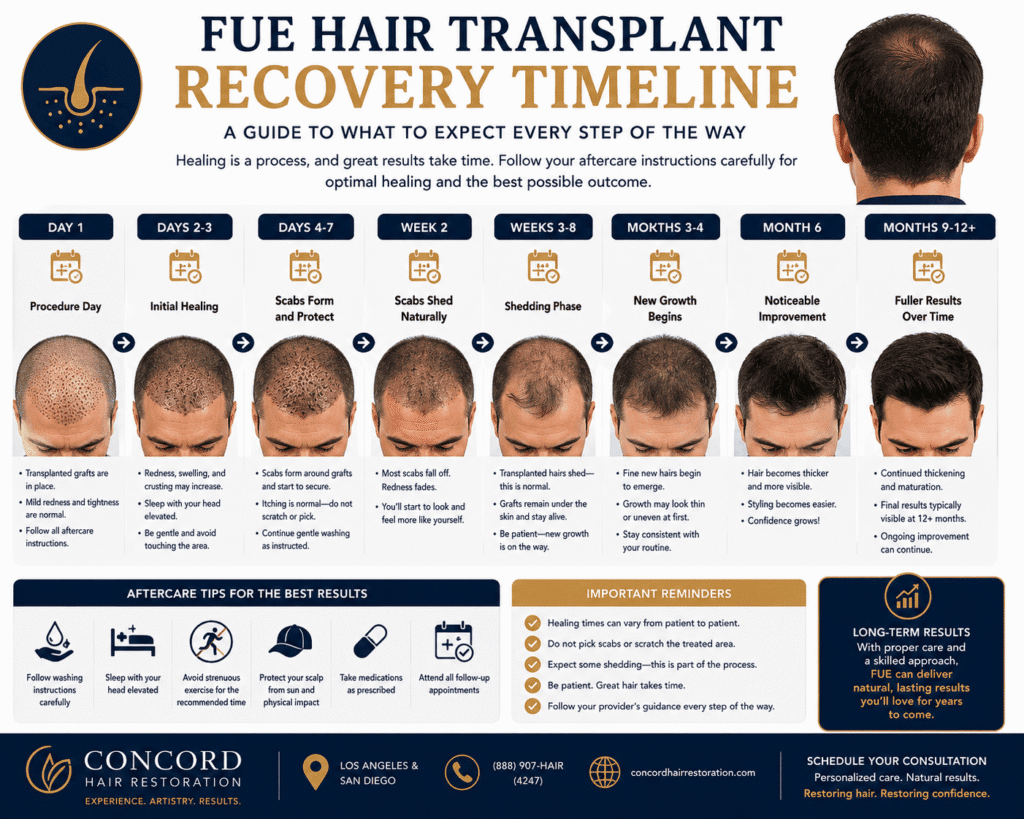
FUE Recovery Timeline
Day 1
The grafts have been placed, and the initial healing process begins.
Patients are generally instructed to protect the recipient area from rubbing, scratching, pressure, and accidental contact.
Days 2–3
Mild swelling, redness, and crusting may become more noticeable.
The donor region begins closing, while the recipient area remains delicate.
Days 4–7
Small scabs are usually visible.
Itching may develop as the skin heals, but patients should avoid picking at the crusts or scratching the recipient area.
Week 2
Many patients look considerably more normal by the second week.
Most scabs have loosened or fallen away according to the clinic’s washing instructions, although residual pinkness may remain.
Weeks 3–8
Many of the visible transplanted hairs shed.
This can alarm patients, but the follicle may remain alive beneath the skin and enter a resting phase before producing a new shaft.
Temporary shock loss can also affect nearby native hair or, less commonly, donor-region hair.
Months 3–4
New hairs may begin emerging.
Early growth can appear:
- Fine
- Uneven
- Light in color
- Wiry or soft
- Sparse compared with the eventual result
Month 6
Many patients notice meaningful cosmetic improvement around the six-month point, although density and maturity are not complete.
Months 7–9
Hair shafts continue thickening, lengthening, and becoming easier to style.
Months 10–12
Many frontal results are substantially developed by approximately one year.
The crown may mature more slowly, and some patients continue noticing improvements beyond 12 months.
For a detailed milestone guide, visit the Hair Transplant Recovery Timeline and Hair Transplant Recovery Timeline in Los Angeles.
When Can You Return to Work?
The answer depends on the patient’s job, procedure size, hairstyle, comfort level, and willingness to be seen with redness or short hair.
Some patients with desk jobs return after several days. Others prefer taking a week or longer so visible scabbing and swelling have more time to settle.
Physically demanding work may require a longer pause because sweating, friction, pressure, and strenuous movement can affect early recovery instructions.
Your clinic should provide guidance based on your procedure and occupation.
When Can You Exercise After FUE?
Exercise restrictions depend on the procedure and physician instructions.
Strenuous exercise may temporarily increase swelling, sweating, blood pressure, or the risk of accidental contact with the scalp. Patients are commonly advised to avoid intense activity during early healing and then resume gradually.
Contact sports require additional caution because direct impact could injure the recipient or donor area.
Follow your own postoperative instructions rather than a fixed online timeline.
When Do FUE Results Become Visible?
FUE results develop gradually.
The procedure does not produce a complete head of long hair immediately. Transplanted shafts commonly shed before new growth appears.
A typical pattern is:
- First two weeks: Healing and crusting
- First two months: Shedding and a relatively quiet appearance
- Months three to four: Early new growth
- Around month six: Noticeable improvement
- Months nine to twelve: Increased maturity and density
- Beyond one year: Continued refinement for some patients, especially in the crown
Hair growth is biological, not instantaneous.
Comparing daily photographs often creates unnecessary anxiety because change is gradual. Monthly images taken under consistent lighting and angles are usually more useful.
Review real outcomes in the Hair Restoration Case Studies, Gallery of Hair Transplant Results, and Before and After Hair Transplant resources.
What Creates Natural-Looking FUE Results?
The extraction method is only one part of a successful procedure.
Natural results depend on several connected decisions.
Hairline Shape
The hairline should complement the patient’s face and age rather than copy a generic template.
Appropriate Use of Single-Hair Grafts
Single-hair grafts near the leading edge can create a softer transition.
Placing large multi-hair units directly at the front may look coarse or unnatural.
Direction and Angle
Grafts must follow natural growth patterns.
Even dense growth can look artificial if hairs point in the wrong direction or emerge too vertically.
Density Distribution
Not every region requires identical density.
Strategic distribution can create the appearance of greater coverage while conserving donor hair.
Donor Preservation
A result cannot be considered successful if the recipient area improves while the donor area becomes noticeably depleted.
Long-Term Planning
The procedure should anticipate the possibility that native hair may continue thinning.
Hair Characteristics
Thick, curly, or low-contrast hair can create greater visual coverage per graft than very fine, straight hair with high contrast against the scalp.
Read Hair Transplant Density Explained and Why Some Hair Transplants Look Unnatural.
Does More Grafts Always Mean Better Results?
No.
Graft count is important, but it is not the only measure of quality.
An unnecessarily high number can:
- Deplete donor reserves
- Increase procedural time
- Place too much demand on a limited recipient area
- Reduce options for future surgery
- Create unrealistic expectations
- Distract from hairline artistry and distribution
A carefully designed procedure with fewer strategically placed grafts may produce a better cosmetic result than a poorly planned procedure using more grafts.
The number should be based on:
- Treatment area
- Desired density
- Donor supply
- Hair caliber
- Curl
- Existing native hair
- Future progression
- Patient priorities
See Why Hair Density Is More Important Than Hair Count and How Many Grafts for a Hair Transplant in Los Angeles?.
FUE Versus FUT
FUE and FUT both transplant follicular units, but they harvest them differently.
FUE
FUE removes follicular units individually with small punches.
Potential advantages may include:
- No single linear donor scar
- Greater flexibility with shorter hairstyles
- Smaller distributed extraction sites
- Reduced healing time for many patients
- Less postoperative discomfort in many cases
- Ability to select individual follicular units
Potential limitations include:
- Risk of overharvesting
- Longer extraction time in some procedures
- Technical difficulty with curved follicles
- Need to trim or shave donor hair in many cases
- Numerous small scars rather than no scarring at all
- Donor supply still remains limited
FUT
FUT removes a strip of donor scalp that is then dissected into follicular units.
Potential advantages may include:
- Efficient harvesting of many grafts
- Preservation of surrounding donor regions for future procedures
- Less need to shave a broad donor area in some cases
- Suitability for certain patients needing larger sessions
Potential limitations include:
- A linear donor scar
- Longer incision healing
- Greater tightness or discomfort for some patients
- Reduced flexibility with very short hairstyles
FUE is often selected by patients who prefer shorter hairstyles or wish to avoid a linear scar, but FUT may remain appropriate in selected cases. The best technique depends on scalp laxity, donor density, hairstyle, graft requirements, surgical history, and long-term planning.
Read the full comparison at FUE Versus FUT.
Does FUE Leave Scars?
FUE does not create the long linear scar associated with strip harvesting.
However, that does not mean it is scar-free.
Each extraction produces a tiny circular wound that heals as a small dot. These points are often difficult to see when harvesting is performed carefully and sufficient surrounding density remains, but visibility can vary according to:
- Punch size
- Skin type
- Healing response
- Number of extractions
- Extraction pattern
- Hair length
- Donor density
- Previous procedures
- Tendency toward abnormal scarring
The accurate claim is that FUE avoids a linear donor scar, not that it creates no scars whatsoever.
Learn more in Do Hair Transplants Leave Scars?.
Potential FUE Risks and Side Effects
Hair transplantation is elective surgery, and no procedure is risk-free.
Possible risks or temporary effects include:
- Redness
- Swelling
- Bleeding
- Infection
- Folliculitis
- Itching
- Numbness
- Temporary shock loss
- Visible scarring
- Uneven growth
- Graft failure
- Overharvesting
- Poor density
- An unnatural hairline
- Cysts or ingrown hairs
- Need for additional treatment
Hair loss can also continue in untreated native areas after surgery, potentially creating an uneven appearance if the original plan did not account for future progression.
Review Hair Restoration Risks and discuss your individual health history during a consultation.
Common FUE Myths
Myth 1: FUE Is Completely Scarless
FUE avoids a long linear scar, but every extracted follicular unit leaves a small healing site.
Myth 2: Every Transplanted Graft Is Guaranteed to Grow
No ethical clinic can guarantee 100% growth. Graft survival depends on surgical technique, handling, recipient blood supply, healing, and patient factors.
Myth 3: FUE Stops Future Hair Loss
FUE moves follicles into thinning areas. It does not stop untreated native follicles from continuing to miniaturize.
Myth 4: The Highest Graft Count Produces the Best Result
Distribution, hairline design, angle, donor conservation, and hair characteristics can matter as much as the total count.
Myth 5: FUE Results Are Immediate
The initial shafts commonly shed. New visible growth usually takes several months.
Myth 6: Anyone With Hair Loss Is a Candidate
Some patients have inadequate donor supply, active scalp disease, unstable loss, or expectations that cannot be met safely.
Myth 7: Technology Performs the Entire Procedure
Devices can assist with harvesting, but medical judgment, design, donor planning, recipient-site creation, and supervision remain essential.
Myth 8: A Hair Transplant Can Restore Unlimited Density
Donor follicles are finite. The objective is meaningful cosmetic coverage, not unlimited replacement of every lost hair.
How Much Does an FUE Hair Transplant Cost?
FUE pricing varies because each plan is customized.
Factors may include:
- Number of grafts
- Size of the treatment area
- Donor density
- Procedure complexity
- Hair texture
- Previous surgery
- Scar repair
- Time required
- Technology used
- Experience of the clinical team
- Follow-up care
- Geographic market
Choosing based only on the lowest price can overlook important issues such as donor preservation, physician involvement, hairline design, graft handling, and continuity of care.
Read the Hair Transplant Cost Guide, learn about Hair Transplant Cost in Los Angeles, or review available Payment Plans and Financing Options.
How to Choose an FUE Clinic
During your research, look beyond advertising language and graft-price promotions.
Ask about:
- Who evaluates candidacy
- Who designs the hairline
- Who performs the extractions
- Who creates recipient sites
- Who places grafts
- How the donor area is measured
- How overharvesting is prevented
- How grafts are stored
- How the team manages curved or textured follicles
- How many patients are treated each day
- What happens if growth is lower than expected
- Whether long-term hair loss is discussed
- Whether before-and-after photos use consistent angles and lighting
- What postoperative support is provided
An informative consultation should include honest discussion of limitations, alternatives, donor supply, and future hair loss.
Use our Guide to Choosing an FUE Hair Clinic in Los Angeles and learn How to Choose the Best Hair Transplant Surgeon in Los Angeles.
Frequently Asked Questions About FUE Hair Transplants
Is FUE permanent?
Transplanted follicles generally retain characteristics from the donor area and can continue producing hair for many years. However, aging, health conditions, and continued loss of native hair can still change the overall appearance over time.
Is FUE suitable for women?
Some women are good candidates, particularly when they have a stable pattern, localized recession, traction alopecia, eyebrow loss, or sufficient donor density. Diffuse thinning requires careful evaluation because the donor area may also be affected.
Learn more about Women’s Hair Loss and Female Hair Transplant Los Angeles.
Can FUE restore a crown?
Yes, crown restoration may be possible when donor supply and long-term planning support it. The crown often requires many grafts because of its size and circular growth pattern, so frontal restoration may take priority in some patients.
Can FUE restore temples?
Yes. Temple and temple-point restoration require especially precise angulation, direction, and use of appropriate grafts.
Read about Temple Point Hair Transplant Los Angeles.
Can Afro-textured hair be transplanted with FUE?
Yes, but curved follicles beneath the skin can make extraction more technically demanding. Specialized equipment, test extractions, and experience with textured hair are important. Published clinical literature describes modified techniques intended to follow the curved course of follicles and reduce transection.
Read Men’s African American Hair Transplant and Ethnic Hair Transplants.
Do you have to shave your head for FUE?
Many procedures require at least partial donor trimming, but the amount varies. Limited-shave or no-shave approaches may be available for selected patients.
How long does FUE take?
Procedure time varies based on graft count, complexity, extraction method, hair characteristics, and the number of clinical steps involved. Larger cases may take most of the day or be divided into more than one session.
Can transplanted hair be cut and styled normally?
After the grafts have healed and new hair has grown, transplanted hair can generally be washed, cut, and styled like other hair.
Can you wear your hair short after FUE?
Many patients choose FUE because it avoids a linear scar and may allow shorter hairstyles. Very close shaving can still reveal small extraction dots, particularly after heavy harvesting or in patients with greater color contrast.
Will transplanted hair turn gray?
Transplanted follicles generally retain characteristics from the donor area, including their tendency to gray over time.
Can you have more than one FUE procedure?
Some patients undergo additional procedures, but feasibility depends on remaining donor density, prior extraction patterns, scalp health, and treatment goals.
Does FUE work for beard or eyebrow restoration?
Individual follicular units can also be used for facial-hair procedures, but the required angles and graft selection differ from scalp transplantation.
Explore FUE Facial Hair Transplant, Beard Transplant Los Angeles, and Eyebrow Hair Transplant.
Final Thoughts
FUE is not simply a machine, punch, or extraction method.
It is a complete surgical process that requires:
- Accurate diagnosis
- Appropriate candidate selection
- Conservative donor management
- Customized hairline design
- Careful graft extraction
- Proper graft preservation
- Precise recipient-site creation
- Thoughtful placement
- Realistic expectations
- Long-term planning
The most natural results are usually not the ones with the lowest hairline, the highest advertised graft count, or the most aggressive one-day transformation.
They are the results that fit the patient’s face, hair characteristics, donor supply, age, and likely future pattern of loss.
Patients considering an FUE Hair Transplant in Los Angeles can learn more about Concord Hair Restoration’s approach, location, consultation process, and treatment planning. Patients closer to San Diego can explore the San Diego Hair Restoration Clinic.
A personalized consultation remains the best way to determine whether FUE is appropriate, how many grafts may be needed, what the donor area can safely support, and what results are realistically achievable.
give me faqs and the schema
Frequently Asked Questions About FUE Hair Transplant Surgery
What is an FUE hair transplant?
FUE, or Follicular Unit Extraction, is a hair transplant technique that removes naturally occurring follicular units individually from the donor area and places them into thinning or bald areas. It avoids the single linear donor scar associated with strip harvesting.
Who is a good candidate for FUE?
Good candidates often have a stable or clearly defined pattern of hair loss, sufficient donor density, a healthy scalp, realistic expectations, and enough donor hair to create a meaningful improvement without overharvesting.
Who may not be ready for FUE?
FUE may not be appropriate for patients with active scarring alopecia, uncontrolled scalp inflammation, unexplained diffuse shedding, inadequate donor density, rapidly progressing hair loss, certain medical concerns, or expectations that cannot be achieved safely.
Is an FUE hair transplant permanent?
Transplanted follicles generally retain the characteristics of the donor area and may continue growing for many years. However, untreated native hair can continue thinning, so long-term planning remains important.
Does FUE leave scars?
FUE avoids a long linear donor scar, but it is not completely scarless. Each extracted follicular unit leaves a tiny circular healing point that may be difficult to see when harvesting is properly distributed and sufficient donor density remains.
How painful is an FUE hair transplant?
FUE is generally performed with local anesthesia. Patients may feel brief discomfort during the numbing process, along with pressure or movement during the procedure, but they should not feel each graft being extracted or placed.
How long does an FUE procedure take?
The length of the procedure depends on graft count, hair characteristics, treatment complexity, the extraction method, and the number of areas being restored. Larger procedures may take most of the day or require more than one session.
How many grafts will I need?
Graft requirements depend on the size of the treatment area, hair-loss stage, desired coverage, donor density, hair caliber, curl pattern, existing native hair, and long-term goals. A personalized consultation is necessary to estimate an appropriate range.
Does a higher graft count always produce better results?
No. Natural-looking results depend on strategic distribution, hairline design, graft direction, donor preservation, and realistic density goals. Using more grafts than necessary may reduce options for future procedures.
How do transplanted grafts survive?
After implantation, grafts initially receive nourishment from the surrounding tissue. New vascular connections then develop between the graft and recipient area. Gentle handling, proper hydration, appropriate storage, precise placement, and postoperative care all influence survival.
Does every transplanted graft grow?
No clinic can ethically guarantee that every graft will survive. Growth may be affected by extraction damage, graft handling, blood supply, healing, smoking, trauma, scalp health, and other patient-specific factors.
Is shedding after FUE normal?
Yes. The visible transplanted hairs often shed during the first several weeks while the follicles remain beneath the skin. New growth commonly begins several months later.
When does new hair start growing after FUE?
Early growth often begins around months three to four. Noticeable improvement may appear around month six, with continued thickening and maturation through months nine to twelve and sometimes beyond.
When can I return to work after FUE?
Some patients with desk jobs return within several days, while others prefer taking a week or longer because of visible redness, swelling, short hair, or scabbing. Physically demanding work may require additional recovery time.
When can I exercise after FUE?
Exercise should be resumed according to the clinical team’s postoperative instructions. Strenuous activity is often restricted during early healing because sweating, increased blood pressure, friction, and accidental contact may affect the scalp.
Can FUE restore the crown?
FUE may be used to restore the crown when donor supply and long-term planning support it. Crown restoration can require many grafts because of the area’s size and circular growth pattern.
Can FUE restore temples and temple points?
Yes, but temple restoration requires precise control of hair direction, angle, density, and graft selection. Poorly positioned temple grafts can look especially unnatural.
Can women have FUE hair transplants?
Some women are good candidates, particularly when they have localized recession, stable traction alopecia, eyebrow loss, scarring, or another clearly defined area with suitable donor hair. Diffuse thinning requires careful evaluation because the donor area may also be affected.
Can Afro-textured or tightly curled hair be transplanted using FUE?
Yes. Curved follicles beneath the skin can make extraction more technically demanding, so experience with textured hair, careful punch selection, and appropriate extraction technique are important.
Do I have to shave my head for FUE?
Many FUE procedures require the donor area to be trimmed, but the amount varies. Partial-shave or limited-shave approaches may be available for selected patients.
Can I wear my hair short after FUE?
Many patients choose FUE because it avoids a linear scar and may be compatible with shorter hairstyles. Very close shaving can still reveal small extraction dots, particularly after extensive harvesting.
What is the difference between FUE and FUT?
FUE removes follicular units individually, creating many small extraction sites. FUT removes a strip of donor scalp, leaving a linear scar. The right technique depends on donor characteristics, scalp laxity, graft needs, hairstyle, prior surgery, and long-term planning.
Can I have another FUE procedure later?
Possibly. The ability to undergo another procedure depends on remaining donor density, prior harvesting patterns, scalp condition, future hair loss, and the number of grafts already used.
Can FUE stop future hair loss?
No. FUE relocates follicles but does not stop untreated native hair from continuing to thin. A long-term strategy may include monitoring, medical management when appropriate, and conservative surgical planning.
How much does an FUE hair transplant cost?
Cost varies according to graft count, treatment area, donor characteristics, complexity, previous surgery, technology, clinical experience, and follow-up care. A consultation is required for an individualized treatment plan.
Does FUE work for beard or eyebrow restoration?
Individual follicular units can also be used for facial-hair procedures, but the required angles and graft selection differ from scalp transplantation.
Explore FUE Facial Hair Transplant, Beard Transplant Los Angeles, and Eyebrow Hair Transplant.
Final Thoughts
FUE is not simply a machine, punch, or extraction method.
It is a complete surgical process that requires:
- Accurate diagnosis
- Appropriate candidate selection
- Conservative donor management
- Customized hairline design
- Careful graft extraction
- Proper graft preservation
- Precise recipient-site creation
- Thoughtful placement
- Realistic expectations
- Long-term planning
The most natural results are usually not the ones with the lowest hairline, the highest advertised graft count, or the most aggressive one-day transformation.
They are the results that fit the patient’s face, hair characteristics, donor supply, age, and likely future pattern of loss.
Patients considering an FUE Hair Transplant in Los Angeles can learn more about Concord Hair Restoration’s approach, location, consultation process, and treatment planning. Patients closer to San Diego can explore the San Diego Hair Restoration Clinic.
A personalized consultation remains the best way to determine whether FUE is appropriate, how many grafts may be needed, what the donor area can safely support, and what results are realistically achievable.