
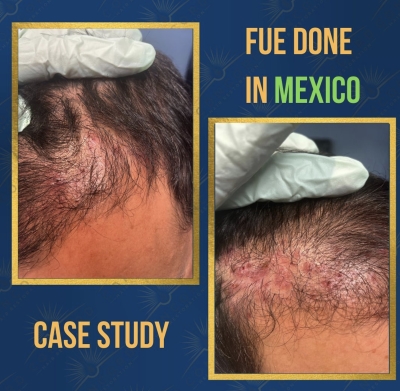
A disappointing hair transplant can be especially frustrating because patients usually undergo the procedure expecting a permanent improvement.
Sometimes the concern is obvious: an unnatural hairline, visible grafts, poor density, or excessive scarring.
Other times, the original transplant may have looked acceptable at first, but continued hair loss around the transplanted area creates an uneven or unnatural appearance years later.
The good news is that some hair transplant results can be improved with corrective treatment.
However, hair transplant repair is often more complicated than performing a first procedure. The available donor hair, previous graft placement, scarring, current hair-loss pattern, and long-term goals all have to be considered before deciding what can realistically be improved.
Professional hair-restoration organizations note that revision cases may involve anything from adding strategically placed grafts to removing poorly positioned grafts, camouflaging scars, or planning treatment over multiple stages. ISHRS
What Is a Hair Transplant Repair?
A hair transplant repair, sometimes called a corrective or revision hair transplant, is treatment designed to improve the appearance of a previous hair restoration procedure.
The goal is not necessarily to erase every sign of the original surgery.
Instead, corrective treatment may focus on making the result look more natural, improving density, repairing an unnatural hairline, addressing visible donor-area damage, or adapting the transplant to continued hair loss.
Every revision case is different.
Some patients may need only a relatively focused correction. Others may require a carefully staged plan over more than one procedure.
Why Would Someone Need a Hair Transplant Revision?
There are two broad reasons someone may seek corrective treatment.
The first is that the original procedure itself created an undesirable result.
The second is that the original result changed in appearance as the patient’s native hair continued to thin.
Hair loss does not necessarily stop after a transplant. If surrounding native hair continues disappearing while transplanted hair remains, the pattern can eventually look isolated or patchy. Additional treatment may sometimes be considered in these situations. American Society of Plastic Surgeons
Signs a Previous Hair Transplant May Need Correction
Patients seeking hair transplant repair may be concerned about issues such as:
- A hairline that looks too straight, low, or artificial
- Grafts placed at unnatural angles
- Visible “pluggy” groups of hair
- Poor or uneven density
- Continued hair loss behind the transplanted area
- Visible donor-area thinning
- Overharvesting from FUE
- Wide or noticeable donor scars
- An unnatural crown pattern
- Limited growth from the original transplant
Some of these issues can potentially be improved. Others may be more difficult, especially when the donor area has already been heavily depleted. ISHRS
Can an Unnatural Hairline Be Fixed?
In some cases, yes.
Hairline problems are among the most noticeable hair transplant concerns because the frontal hairline frames the face.
An unnatural result may occur when a hairline is positioned too low, designed too symmetrically, created without enough irregularity, or built using grafts that appear too thick at the front.
Hair direction also matters.
Natural hairs do not simply grow straight upward across the entire hairline. Angle, direction, spacing, and the transition into greater density all influence whether the result looks believable.
Depending on the original procedure and remaining donor supply, corrective treatment may involve adding finer grafts around the existing hairline, redistributing visual density, or addressing poorly positioned grafts.
The best approach depends on the individual case.
We explain the design principles behind natural results in What Makes a Hairline Look Natural?.
Can Poor Hair Transplant Density Be Improved?
Sometimes.
Low density may result from several different situations.
The original procedure may not have included enough grafts for the size of the treatment area. Some grafts may not have grown as expected. Existing hair may have continued thinning after surgery. Or the grafts may have been distributed in a way that does not create enough visual coverage.
A second procedure may sometimes improve density by adding carefully selected grafts between or around existing transplanted hair.
However, more grafts are not automatically the solution.
The donor area has to be evaluated first.
Hair restoration uses a limited supply of donor follicles, so the long-term goal should be to use that supply strategically rather than simply transplant the largest possible number.
You can learn more in our guide to Hair Transplant Density.
What Is Donor Area Overharvesting?
The donor area is usually located along the back and sides of the scalp.
During FUE, individual follicular units are removed from this region.
If too many grafts are removed, or if extraction is concentrated too heavily in particular areas, the donor region may become visibly thin or uneven.
The International Society of Hair Restoration Surgery notes that excessive FUE harvesting can create a thin or “moth-eaten” appearance and may significantly complicate future restoration. ISHRS
This is one of the reasons donor management is so important during the first hair transplant.
Once donor follicles are removed, the available supply for future procedures becomes more limited.
Read more about donor area management and overharvesting.
Can an Overharvested Donor Area Be Fixed?
This can be one of the more challenging types of hair transplant repair.
The answer depends on the amount of remaining donor hair, the pattern of extraction, scarring, hairstyle preferences, and the severity of the damage.
Some patients may have enough remaining donor hair to strategically improve certain areas.
In other situations, additional transplantation may not be advisable because removing more hair could make the donor area worse.
The ISHRS specifically cautions that limited donor hair can make further corrective surgery inappropriate in some patients.
That is why the first step in a repair case should be a careful assessment rather than immediately scheduling another transplant.
Can Hair Transplant Scars Be Improved?
Hair transplantation is surgery, so some degree of scarring can occur.
The appearance of scars depends partly on the surgical technique, healing response, previous procedures, and how the donor area was treated.
FUT can leave a linear donor scar, while FUE creates many small extraction sites rather than a long linear incision.
Corrective options vary depending on the scar.
In some situations, hair may potentially be transplanted into or around scarred areas. Scalp micropigmentation may also be considered in selected cases to reduce the visual contrast between the scalp and surrounding hair.
Not every scar can be made invisible.
A consultation is necessary to determine what improvement may realistically be possible.
You can also read our guide: Do Hair Transplants Leave Scars?.
What If the Hair Transplant Looked Good at First but Hair Loss Continued?
This is different from a poorly performed transplant.
A technically successful transplant can still look different years later if the surrounding native hair continues to thin.
Imagine restoring the frontal hairline while the hair behind it gradually disappears.
The transplanted hair may remain, but the relationship between the transplanted and native hair changes.
That is one reason long-term planning matters so much.
A hair transplant should ideally account for the possibility that pattern hair loss will continue.
In some cases, additional transplantation may be considered later to restore areas that have progressively thinned.
We cover this more fully in What Happens If You Continue Losing Hair After a Hair Transplant?.
What Can Be Done About Poorly Placed Grafts?
Poor graft placement can affect the appearance of a transplant even when the grafts themselves grow successfully.
Problems may include overly thick grafts at the hairline, hairs growing at the wrong angle, grafts placed too far forward, or grafts that do not follow the surrounding growth pattern.
Hair transplant revision may sometimes involve removing selected grafts or placing additional grafts around them to create a more natural transition.
Corrective cases can be technically demanding because the physician is working with an area that has already undergone surgery.
The ISHRS notes that repair may require graft removal, additional donor hairs, or multiple corrective procedures depending on the problem.
Can a Bad Crown Hair Transplant Be Repaired?
Potentially.
The crown is particularly dependent on hair direction because natural crown hair grows in a whorl or spiral pattern.
If grafts are placed at angles that do not match the natural crown pattern, the result may appear artificial.
Repair planning may involve improving the visual flow of the crown, adding strategically placed grafts, or blending the transplanted area with remaining native hair.
The available donor supply is especially important because the crown can consume a large number of grafts.
That is why a repair plan has to consider the rest of the scalp—not only the crown itself.
How Soon Can a Hair Transplant Be Corrected?
Patients are often understandably eager to fix a result they do not like.
But a hair transplant needs time to heal and mature.
Hair growth develops gradually, and early postoperative appearance does not represent the final result.
Before deciding that a transplant has failed or needs revision, the treating physician may recommend waiting long enough to evaluate growth, density, healing, and the final pattern.
The appropriate timing depends on the problem being addressed.
If there are signs of an actual medical complication—such as significant infection, abnormal wound healing, or another urgent concern—the original clinic or another qualified medical professional should be contacted promptly rather than waiting for the cosmetic result to mature.
Hair transplantation carries potential surgical risks including infection, scarring, poor graft growth, bleeding, and altered scalp sensation. Cleveland Clinic
For normal growth expectations, see our Hair Transplant Timeline.
Does Every Hair Transplant Repair Require Another Surgery?
No.
The right solution depends on the problem.
Some patients may benefit from additional surgery.
Others may have limited donor hair or a situation where another transplant would create more risk than benefit.
Non-surgical camouflage techniques such as scalp micropigmentation may sometimes be considered for visible thinning or donor scars. Hairstyle changes may also help disguise certain problems.
ISHRS guidance emphasizes that corrective surgery should not automatically be performed when the donor supply is inadequate or when the patient’s goals exceed what remaining hair can reasonably provide.
What Determines Whether a Hair Transplant Can Be Repaired?
A repair consultation should look at the entire scalp rather than only the area that bothers the patient most.
Important factors include the quality and amount of remaining donor hair, previous harvesting pattern, scarring, graft direction, hairline placement, current density, future hair-loss progression, hair caliber and texture, and the patient’s expectations.
That evaluation helps determine whether correction may be possible and what tradeoffs may be involved.
Hair transplant candidacy in general depends heavily on having adequate healthy donor hair, because all transplant techniques rely on the patient’s existing follicles. American Society of Plastic Surgeons
Why Repair Surgery Requires Careful Planning
A revision procedure is often more complicated than a first hair transplant.
The physician has to work around existing grafts, previous extraction sites, possible scar tissue, and a donor area that may already have been partially used.
That makes conservative planning especially important.
A poorly planned second procedure can potentially create additional scarring or further deplete the donor region.
The goal should therefore be realistic improvement—not promising that every previous problem can be completely erased.
Questions to Ask During a Hair Transplant Repair Consultation
A repair consultation should help you understand exactly what went wrong, what can realistically be improved, and what limitations remain.
Ask how much usable donor hair is still available, whether previous grafts need to be removed or camouflaged, whether additional transplantation is appropriate, how continued hair loss could affect the repair, whether treatment may require multiple stages, and what the donor area may look like afterward.
You should also ask to see examples of corrective cases that are similar to yours.
Professional guidance emphasizes that repair work can be substantially different from routine first-time transplantation and should be approached with realistic expectations.
Frequently Asked Questions About Hair Transplant Repair
Can a bad hair transplant really be fixed?
Some poor or unnatural hair transplant results can be improved, but the amount of correction possible varies by patient. Donor supply, scarring, graft placement, previous procedures, and continuing hair loss all influence the options.
Can an unnatural hairline be corrected?
In certain cases, additional graft placement or selective removal of problematic grafts may improve the appearance of an unnatural hairline.
Can hair transplant plugs be repaired?
Older large grafts or “pluggy” results may sometimes be improved through modern corrective techniques, although more than one procedure may be necessary in complex cases.
Can overharvesting be reversed?
Removed donor follicles cannot simply be restored to their original state. Depending on the remaining donor supply and appearance of the area, treatment may focus on improving or camouflaging the damage rather than fully reversing it.
Can you have another hair transplant after a failed one?
Possibly. The key question is whether enough healthy donor hair remains and whether another procedure is likely to improve the situation without creating additional problems.
How many procedures does hair transplant repair take?
It varies. Some cases may be addressed in one procedure, while more complicated revision cases may require multiple stages.
What if my hair transplant looks unnatural because I lost more hair afterward?
Additional hair loss around transplanted follicles can change the overall appearance. A new evaluation can determine whether further restoration may be appropriate.
Considering Hair Transplant Repair?
If you’re unhappy with a previous hair transplant, the first step should not be deciding how many more grafts to add.
The first step is understanding why the current result looks the way it does.
Concord Hair Restoration can evaluate the existing transplant, remaining donor supply, hairline design, density, scarring, continuing hair loss, and long-term goals before discussing what options may be appropriate.
For patients in Los Angeles, learn more about our overall approach to hair transplant treatment in Los Angeles or our FUE Hair Transplant Los Angeles guide.
Concord Hair Restoration – Encino
16661 Ventura Blvd., Suite 703
Encino, CA 91436
(818) 800-2002