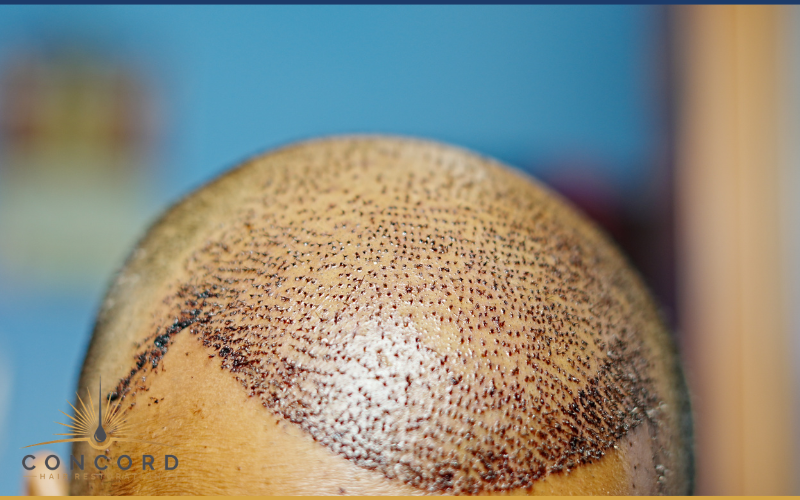
After a hair transplant, one of the first visible changes patients notice is the appearance of small crusts or scabs around the transplanted hairs.
That can lead to an understandable question:
When do hair transplant scabs fall off?
Small scabs are commonly part of the early healing process after hair transplantation. They form around the tiny recipient sites where individual follicular units have been placed.
Over time, these crusts generally begin to loosen as the scalp heals.
The important part is not trying to rush the process.
Picking, scratching, or aggressively rubbing the recipient area before your surgeon says it is safe can irritate healing skin and potentially interfere with the recovery process.
At Concord Hair Restoration, patients receive individualized post-operative instructions because healing timelines can vary from one person to another.
Why Do Scabs Form After a Hair Transplant?
Hair transplantation involves creating very small openings in the scalp.
With FUE hair transplantation, individual follicles are removed from a donor area and carefully placed into recipient sites in areas affected by thinning or hair loss.
The scalp naturally responds to these tiny treatment sites by beginning the healing process.
Small amounts of blood and fluid may dry around the transplanted hairs, forming tiny crusts.
These are commonly referred to as hair transplant scabs.
Their appearance does not automatically indicate that something is wrong.
In many cases, they are simply a visible sign that the skin is healing.
What Do Hair Transplant Scabs Look Like?
Scabs after a hair transplant are usually small and located around individual transplanted hairs.
Depending on the patient and the procedure, the recipient area may temporarily appear:
- red
- dotted
- crusted
- slightly swollen
- dry
- uneven in texture
This can look dramatic when viewed closely, particularly because patients tend to inspect their scalp much more carefully after surgery than they normally would.
The appearance of the scalp during the first days of recovery is not the final appearance of the transplant.
When Do Hair Transplant Scabs Start Forming?
Small crusts can begin forming relatively soon after the procedure as the tiny recipient sites start healing.
They may become more noticeable during the first several days.
As recovery progresses, the scabs typically begin to dry and loosen.
Exactly how quickly this happens depends on factors such as:
- the extent of the procedure
- the number of grafts
- individual healing
- scalp condition
- post-operative care
- the washing instructions provided by your surgeon
There is no reason to compare your scalp day-by-day with another patient’s photographs online.
When Do Hair Transplant Scabs Fall Off?
Hair transplant scabs generally loosen gradually during the early recovery period rather than disappearing all at once.
Many patients notice that crusting improves over the first couple of weeks, but the exact timing varies.
Your surgeon may provide instructions about when gentle washing or specific scalp-care techniques can be used to help loosen remaining crusts.
Follow those instructions closely.
Do not assume that a scab is ready to be removed simply because it looks dry.
Should You Pick Hair Transplant Scabs?
No — patients should generally avoid picking at fresh hair transplant scabs.
It may be tempting, especially if:
- the scalp feels itchy
- the crusts look loose
- you can see them in the mirror
- you want the recipient area to look normal faster
But picking introduces unnecessary mechanical force to an area that is still healing.
It can also irritate the skin or cause bleeding.
Allow the scabs to loosen naturally and according to your clinic’s washing instructions.
Can Picking Scabs Damage Hair Grafts?
The safest approach is to avoid intentionally picking or scratching the recipient area during early healing.
The transplanted follicles are placed into small recipient sites that need time to stabilize.
Aggressive scratching, rubbing, or pulling at crusts can traumatize healing tissue.
If you accidentally touch a scab, do not automatically assume you have lost a graft.
However, if you notice:
- active bleeding
- significant pain
- unusual swelling
- visible trauma
- another concerning change
contact your hair restoration provider.
Can You Wash Hair Transplant Scabs Off?
Washing is normally part of post-operative care, but the technique matters.
During early recovery, patients may receive instructions to cleanse the scalp very gently.
Depending on your surgeon’s recommendations, this may involve:
- lukewarm water
- gentle shampoo
- reduced water pressure
- avoiding direct scrubbing
- avoiding fingernails
- gently rinsing the scalp
As the recipient area heals, washing may eventually help remaining crusts loosen naturally.
You can read our full guide on when you can wash your hair after a hair transplant for more detail.
Should You Rub Scabs Off in the Shower?
Not until your hair transplant physician says it is appropriate.
There is a major difference between:
gentle cleansing
and
aggressively scrubbing the scalp until every scab disappears.
During the earliest healing stage, aggressive rubbing is generally something patients should avoid.
Later in recovery, your clinic may provide instructions for gradually returning to more normal washing.
Follow your surgeon’s timeline rather than trying to remove all visible crusting as quickly as possible.
What If the Scabs Are Itchy?
Itching can occur as skin heals.
Unfortunately, itching can also make patients want to scratch the exact area they are supposed to protect.
Try not to use your fingernails on the recipient area.
If itching becomes significant or uncomfortable, contact your hair transplant clinic.
Your physician can tell you whether what you are experiencing appears normal and whether any approved treatment may help.
Can You Use Oil or Moisturizer on Hair Transplant Scabs?
Do not automatically apply oils, creams, lotions, or moisturizers to the recipient area unless your clinic has told you to use them.
A product that seems harmless may not be part of your physician’s recommended recovery protocol.
Follow the products and instructions supplied by your hair transplant team.
The early recovery period is not the best time to experiment with home remedies.
What Happens After the Scabs Fall Off?
Once crusting begins to disappear, the recipient area may start looking cleaner and more natural.
However, that does not mean the hair transplant result is complete.
The transplanted hairs are still at the beginning of a much longer growth process.
Some visible hairs may eventually shed.
This can be surprising because patients often assume that once the scalp has healed externally, all transplanted hairs should immediately continue growing.
Hair follicles do not work that way.
They progress through biological growth cycles.
For some patients, temporary shedding may occur before new growth develops.
You can read more about this in our guide to shock loss after a hair transplant.
Is It Normal for Hairs to Come Out With Scabs?
Patients sometimes notice small hairs associated with crusts as the scalp heals.
Seeing a hair shaft does not automatically mean that the entire transplanted follicle has been lost.
The visible hair and the follicle beneath the skin are not the same thing.
Post-transplant shedding can occur as follicles move through their growth cycle.
However, if you see significant bleeding or are concerned that a graft has been displaced, contact your physician rather than trying to determine the answer from appearance alone.
How Do You Know If You Lost a Graft?
This can be difficult for a patient to determine visually.
That is why photographs found online are not a reliable way to diagnose your own recovery.
If you experience an incident involving:
- significant scratching
- direct trauma
- bleeding
- accidental impact
- aggressive rubbing
and you are worried about a graft, contact your hair transplant clinic.
Your medical team is in a much better position to evaluate whether the recipient area needs attention.
What If Scabs Are Still Present After Other Patients’ Have Fallen Off?
Recovery varies.
One patient may heal more quickly than another.
Differences may be related to:
- skin type
- procedure size
- scalp condition
- graft density
- post-operative care
- individual healing response
Do not force remaining scabs off simply because another patient online had a different timeline.
If crusting seems to be lasting longer than expected, ask your physician.
Can Hair Transplant Scabs Cause Scarring?
Scabbing itself is part of normal wound healing.
Problems are more likely to arise if the scalp experiences repeated trauma, scratching, infection, or other complications.
Patients should follow post-operative instructions carefully and contact their provider if healing does not appear to be progressing normally.
FUE is designed around small individual extraction and recipient sites, but proper aftercare still matters.
What About Scabs in the Donor Area?
The donor area can also develop small crusts.
Remember that a hair transplant involves two separate treatment areas:
Donor area: where follicular units are harvested.
Recipient area: where those follicles are transplanted.
The two areas may look and feel different during recovery.
Your physician may also give you different washing or care instructions for each area.
Avoid assuming that because one area feels healed, the other can be treated the same way.
Can Exercise Affect Hair Transplant Scabs?
Strenuous exercise can cause sweating and may increase the temptation to wipe or rub the scalp.
It can also expose healing skin to gym equipment, towels, hats, and other surfaces.
That is one reason patients may be instructed to limit strenuous exercise during early recovery.
For a more detailed explanation, see our guide to exercise after a hair transplant.
Should You Wear a Hat Over Hair Transplant Scabs?
Ask your surgeon before wearing headwear over the recipient area.
Some hats can create:
- friction
- pressure
- heat
- sweating
- direct contact with transplanted areas
The answer can depend on the hat style, where the transplant was performed, and how far you are into recovery.
Don’t use a hat simply to hide scabs without first making sure it is appropriate.
How Can You Help Your Scalp Heal Properly?
The best thing patients can do is follow their post-operative instructions.
That typically means being careful about:
- washing
- touching
- scratching
- exercise
- sleeping position
- sun exposure
- hats
- hair products
- swimming
Your clinic may give you more specific instructions based on your procedure.
Hair transplant recovery is not a competition to see how quickly you can get back to normal.
Protecting the scalp during early healing is more important than making the transplant look perfect immediately.
When Should You Contact Your Doctor About Hair Transplant Scabs?
Contact your provider if you experience symptoms that seem unusual or differ from the recovery expectations you were given.
Examples may include:
- increasing pain
- worsening redness
- significant swelling
- discharge
- persistent bleeding
- unpleasant odor
- fever
- trauma to the recipient area
Your physician can determine whether the scalp is healing normally or needs to be evaluated.
Don’t Judge Your Hair Transplant by the Scabbing Stage
The first several days after a hair transplant can be visually awkward.
Patients may see:
- redness
- crusting
- short transplanted hairs
- swelling
- uneven texture
None of those things represent the final hair transplant result.
Hair transplantation is a process.
First, the scalp heals.
Then some visible hairs may shed.
Then follicles enter new growth phases.
Then the new hair gradually becomes more noticeable.
Our hair transplant timeline explains the broader progression.
Why Patience Matters During Recovery
Patients often spend years thinking about hair restoration before finally having a procedure.
Understandably, once the procedure is complete, they want to see the finished result immediately.
But the scalp and hair follicles operate on their own biological timeline.
Trying to accelerate recovery by:
- picking scabs
- scrubbing aggressively
- applying unapproved products
- returning to activities too quickly
does not make hair grow faster.
Following your physician’s instructions and giving the scalp time to heal is the better strategy.
Considering a Hair Transplant in Los Angeles?
Understanding what recovery actually looks like can help patients feel more comfortable before having a procedure.
At Concord Hair Restoration, patients receive personalized guidance about their hair transplant, graft placement, post-operative care, and expected recovery.
If you’re considering a hair transplant in Los Angeles, our Encino team can explain what you may experience during the healing process and answer questions about your individual treatment plan.
Los Angeles Office
Concord Hair Restoration
16661 Ventura Blvd., Suite 703
Encino, CA 91436
(818) 800-2002
FAQs About Hair Transplant Scabs
Are scabs normal after a hair transplant?
Small crusts or scabs can form around transplant sites as the scalp begins healing. Their appearance during early recovery does not automatically indicate a problem.
When do hair transplant scabs fall off?
Scabs generally loosen gradually during the early recovery period. Many patients notice significant improvement over the first couple of weeks, although individual healing timelines vary.
Should I pick the scabs after a hair transplant?
Patients should generally avoid intentionally picking, scratching, or aggressively rubbing fresh scabs. Follow your surgeon’s instructions for washing and scalp care.
Can I wash hair transplant scabs off?
Gentle washing is commonly part of post-operative care, but patients should follow the specific washing technique and timeline provided by their hair transplant clinic.
Does a hair coming out with a scab mean I lost a graft?
Not necessarily. The visible hair shaft is different from the transplanted follicle beneath the skin. Contact your physician if shedding is accompanied by bleeding, pain, or other concerning symptoms.
Why are my hair transplant scabs itchy?
Itching can occur while skin heals. Avoid scratching the recipient area and contact your provider if itching becomes significant or concerning.
Can I wear a hat while I still have hair transplant scabs?
Ask your surgeon before wearing headwear over the recipient area because certain hats may create pressure, friction, heat, or contact with healing tissue.
When should I call my doctor about hair transplant scabs?
Contact your provider if you experience increasing pain, worsening redness, significant swelling, discharge, persistent bleeding, fever, or another symptom that differs from the recovery instructions you were given.