One of the biggest concerns after a hair transplant is simple:
Will the transplanted grafts survive?
It is common for patients to worry about washing their hair, sleeping the wrong way, touching the scalp, seeing hairs shed, or accidentally doing something that could affect their results.
Understanding what happens beneath the surface can make the recovery process much less stressful.
A transplanted hair graft is living follicular tissue. Once it has been moved from the donor area into its new location, it must survive the early healing period, establish circulation with the surrounding scalp, and eventually return to an active hair-growth cycle.
That process does not happen instantly.
In this guide, we’ll explain how hair graft survival works, when grafts become more secure, why transplanted hairs often shed, what can affect graft survival, and when patients may begin seeing new growth.
Patients who want a broader overview of the procedure can also read our complete FUE hair transplant guide.
What Is a Hair Graft?
During a modern hair transplant, hair is generally moved in naturally occurring follicular units.
A follicular unit may contain one or several hairs along with surrounding tissue necessary to support the follicles.
During FUE, these follicular units are carefully removed from an appropriate donor area and transplanted into recipient sites where additional coverage is desired.
The procedure sounds straightforward, but each graft has to remain viable during several important steps:
- Extraction
- Handling
- Temporary storage
- Placement
- Early healing
- Reconnection with the recipient area’s circulation
This is one reason hair transplantation is about much more than simply achieving the highest possible graft number.
The quality of graft handling and placement matters.
If you’re researching the donor side of the procedure, our guide to donor hair and the hair transplant donor area explains where transplanted follicles come from and why donor supply is limited.
What Happens Immediately After a Hair Graft Is Transplanted?
When a follicular unit is first placed into its recipient site, it does not immediately have the same established blood supply it had in its original location.
The surrounding scalp begins supporting the graft while microscopic healing takes place.
During this early period, the transplanted tissue receives oxygen and nutrients from the surrounding environment while new vascular connections develop.
This is why the first stage of healing is especially important.
Patients are typically instructed to avoid unnecessary friction, scratching, picking, or trauma while the grafts are becoming established.
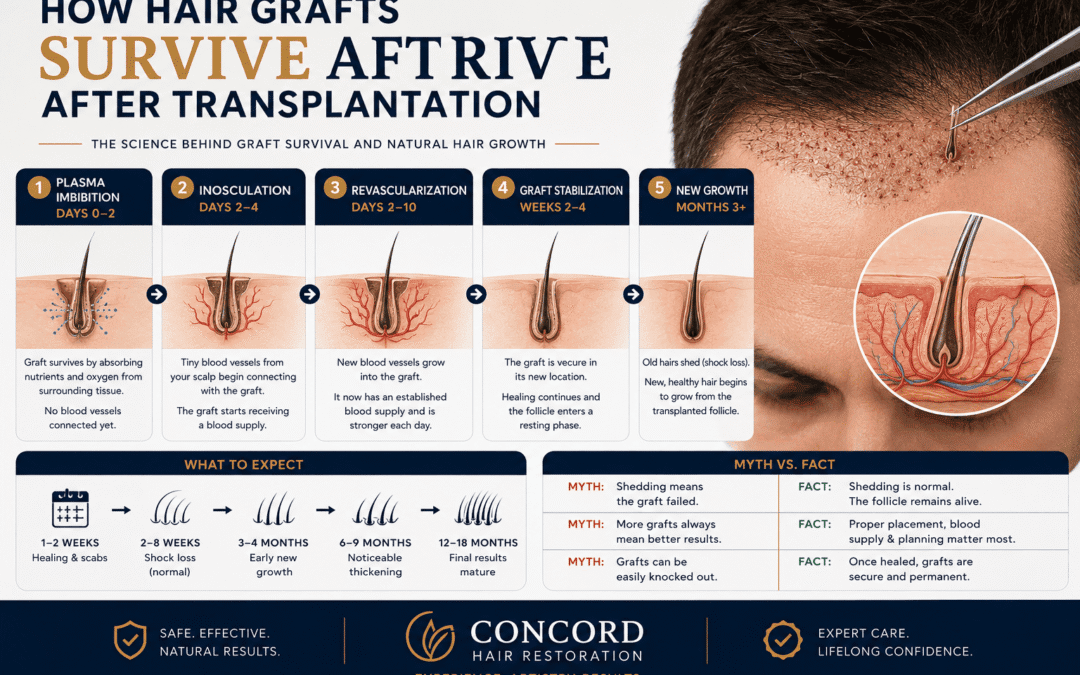
How Do Transplanted Hair Grafts Get a New Blood Supply?
The early healing process is often described in several overlapping stages.
Early Nutrient Diffusion
Immediately after placement, the graft temporarily relies on oxygen and nutrients from the surrounding recipient tissue.
This early phase is sometimes described as plasma imbibition.
The graft does not yet have mature vascular connections of its own.
Early Vascular Connections
As healing progresses, tiny blood vessels in the recipient area begin forming connections with vessels associated with the transplanted tissue.
This process is commonly described as inosculation.
Revascularization
Additional microscopic blood vessels develop around and into the healing graft.
This process helps establish the circulation necessary to support the transplanted follicle over the longer term.
The exact timing of these stages is biological rather than an identical clock for every patient, which is why aftercare instructions should come from the treatment team rather than from a generic day-by-day schedule found online.
Why Blood Supply Matters for Hair Graft Survival
Hair follicles need oxygen and nutrients to remain healthy.
That makes circulation an important part of transplant planning and healing.
Recipient-site design must consider more than simply fitting as many grafts as possible into a small area.
Hair transplant density involves balancing visual coverage with factors such as:
- Available donor supply
- Follicular-unit characteristics
- Recipient-area size
- Existing hair
- Hair caliber
- Graft placement
- Long-term planning
Our guide to hair transplant density and realistic coverage explains why a larger graft number does not automatically mean a better-looking result.
When Do Hair Transplant Grafts Become Secure?
Grafts become progressively more anchored as the scalp heals.
They are most vulnerable to physical displacement during the earliest postoperative period.
One study specifically examined how long transplanted grafts remained susceptible to being manually dislodged. Grafts became increasingly secure over the first week, and by about nine days they could no longer be dislodged in the study’s testing. The presence of adherent crusts extended the period of vulnerability when patients pulled on them. PubMed
This is one reason patients are warned not to pick at scabs.
It is also why there is no need to repeatedly “test” whether a graft is secure.
Follow the washing and aftercare instructions you were given and allow the scalp to heal normally.
For additional guidance, read our hair transplant aftercare instructions.
Can You Accidentally Knock Out a Hair Graft?
During the earliest stage of recovery, significant rubbing, scratching, or direct trauma can potentially disturb a newly transplanted graft.
As healing progresses, this becomes increasingly difficult.
Patients sometimes worry that every tiny sensation or accidental touch has destroyed a follicle.
That is usually not a useful way to think about recovery.
The goal during the first several days is simply to protect the recipient area from unnecessary trauma and follow your postoperative instructions.
If you are concerned that you may actually have dislodged a graft, contact the clinic rather than trying to determine it from online photographs.
Why Do Transplanted Hairs Fall Out?
One of the most alarming moments for some patients occurs when transplanted hairs begin shedding.
They may assume:
“My grafts are falling out.”
Usually, the visible hair shaft and the transplanted follicle are not the same thing.
After transplantation, follicles can temporarily enter a resting phase. The visible hairs may shed while the follicular structures remain beneath the scalp.
That shedding is part of the reason a hair transplant does not look progressively better every single day after surgery.
There may be an early period when the scalp heals but much of the transplanted hair is no longer visible.
For a deeper explanation, read about shock loss after hair transplant surgery.
Does Shedding Mean a Hair Graft Failed?
Not necessarily.
Hair shedding and graft failure are different events.
With normal postoperative shedding, the visible hair shaft is lost while the follicle remains beneath the surface.
With graft failure, the transplanted follicular unit does not survive sufficiently to produce the expected new hair.
You cannot determine graft survival simply by counting how many short hairs you see shedding during early recovery.
New growth takes time.
When Does Transplanted Hair Start Growing Again?
The transplanted follicles usually need to pass through a resting period before producing noticeable new hair.
The progression commonly looks something like this:
Early weeks: the scalp heals and transplanted hairs may shed.
Following months: follicles remain beneath the skin while the growth cycle resets.
Around the first several months: early new hairs may begin appearing.
Later months: additional growth, thickening, and maturation can continue.
Patients should expect considerable individual variation.
The scalp may look healed long before the final hair-transplant result develops.
For a more detailed month-by-month explanation, visit our hair transplant recovery and growth timeline.
What Determines Whether Hair Grafts Survive?
There is no single factor responsible for graft survival.
Successful transplantation depends on the entire process.
Important considerations include:
Careful Extraction
Follicular units need to be harvested without unnecessary damage.
Graft Handling
Transplanted tissue is delicate.
Careful handling helps protect the follicular unit between extraction and implantation.
Graft Hydration and Storage
Follicles must be managed appropriately while outside the body.
A 2025 expert consensus on FUE graft survival specifically addressed graft harvesting, trimming, preservation, implantation, postoperative care, and complication prevention as parts of an overall approach to improving graft survival. PubMed
Recipient-Site Preparation
Placement needs to account for spacing, angle, direction, and available recipient tissue.
Patient Healing
Individual health and healing can influence recovery.
Aftercare
Protecting the scalp during the early postoperative period remains important.
Does a Higher Graft Count Mean Better Survival?
No.
Graft count tells you how many follicular units are being transplanted.
It does not tell you:
- How many hairs those grafts contain
- How carefully they were handled
- Whether the donor area was overharvested
- Whether the recipient density is appropriate
- Whether the hairline was designed naturally
- How many follicles will ultimately grow
This is why patients should not choose a hair transplant based entirely on which clinic offers the largest graft number.
If you’re trying to understand your own estimate, read our guide to how many hair transplant grafts you may need.
Can Too Many Grafts Be Placed in One Area?
The goal is not to pack an unlimited number of grafts into the smallest possible space.
Recipient-site planning must consider the condition of the scalp, existing hair, available donor supply, desired density, and the patient’s long-term hair-loss pattern.
Creating visually convincing density is an aesthetic and surgical planning problem—not simply a math problem.
This is especially important at the frontal hairline, where single-hair graft selection, direction, irregularity, and gradual density changes can strongly influence whether the result looks believable.
Read more about what makes a transplanted hairline look natural.
Can Washing Your Hair Affect Graft Survival?
Patients often become nervous about washing the scalp after surgery.
But appropriate cleansing is part of normal postoperative care.
The key is how and when the washing is performed.
Early after surgery, patients may be given specific instructions designed to clean the scalp without aggressive rubbing.
You should avoid improvising.
Follow the washing schedule and technique provided by your treatment team.
Picking at scabs or aggressively scratching the recipient area is very different from properly performed gentle cleansing.
What About Sleeping After a Hair Transplant?
Another common concern is whether sleeping in the wrong position will cause every graft to fail.
During the first nights after surgery, your treatment team may recommend a particular position—often including some degree of head elevation—to help manage swelling and protect the healing recipient area.
The important goal is to avoid unnecessary contact or rubbing against newly transplanted regions while following your specific postoperative instructions.
Recovery recommendations can differ based on where the grafts were placed and the size of the procedure.
Does Smoking Affect Hair Graft Survival?
Smoking can reduce blood flow and oxygen delivery to healing tissue.
Because graft healing depends on a healthy local environment and developing circulation, smoking is an important topic to discuss before and after a hair transplant.
Patients should follow their clinician’s individualized recommendations regarding smoking and nicotine use rather than assuming that normal habits can continue unchanged through surgery and recovery.
Can Infection Affect Graft Survival?
Hair transplantation is generally considered a safe procedure when performed appropriately, but it is still surgery.
Infection, inflammation, poor healing, and other postoperative complications can potentially affect the scalp and final result.
A recent systematic review found that modern hair transplantation is generally safe, while also documenting complications involving donor and recipient sites. PubMed
If you experience concerning symptoms after surgery, contact your treatment team instead of attempting to self-diagnose the problem online.
Does PRP Improve Hair Graft Survival?
PRP is sometimes discussed as an adjunct to hair transplantation.
Research has suggested potential benefits, but the evidence specifically involving transplantation remains limited and protocols vary.
A 2025 systematic review found possible improvements in measures including density, follicle survival, and earlier growth in the studies reviewed, but it also emphasized substantial differences in PRP preparation and study methods and called for stronger standardized trials. PubMed
For patients, the important takeaway is that good surgical technique and postoperative care remain fundamental.
An adjunctive treatment should not be treated as a substitute for careful graft harvesting, handling, placement, and recovery.
What Does Hair Graft Failure Look Like?
It can be difficult for a patient to determine graft survival during the early months simply by looking in the mirror.
Normal postoperative changes can include:
- Shedding
- Temporary redness
- Scabbing
- Uneven early growth
- Fine initial hairs
- Areas that grow at different speeds
That means an area looking sparse a few weeks after transplantation does not automatically indicate graft failure.
Hair transplant results should be evaluated over the appropriate growth timeline.
Why Some Grafts May Grow Earlier Than Others
Hair growth does not occur in perfect synchronization.
Some transplanted follicles may begin producing visible hairs earlier, while others remain in a resting phase longer.
Early growth may also appear:
- Thin
- Fine
- Uneven
- Lighter than expected
- Less dense than the final appearance
As the months progress, those hairs can continue maturing.
This is one reason comparing your scalp week by week can create unnecessary anxiety.
Hair Graft Survival vs. Hair Transplant Success Rate
These two concepts are related but not identical.
Graft survival refers to whether transplanted follicular units survive and eventually produce hair.
Hair transplant success is broader.
A technically surviving graft does not automatically guarantee an aesthetically successful transplant.
The final result also depends on:
- Hairline design
- Density
- Graft distribution
- Angle
- Direction
- Donor management
- Continued native hair loss
- Patient expectations
A transplant with excellent follicle survival could still look unnatural if the grafts were poorly designed or distributed.
That distinction is important when evaluating hair-transplant results.
How Patients Can Help Protect Transplanted Grafts
Your treatment team handles the surgical portion.
Your job afterward is largely to provide a good healing environment.
That generally means following instructions involving:
- Washing
- Sleeping position
- Exercise
- Sun exposure
- Headwear
- Medication
- Scalp touching
- Follow-up appointments
You do not need to constantly inspect or test your grafts.
In fact, repeatedly touching or picking at the recipient area can create the very irritation you’re trying to avoid.
Let the scalp heal.
Hair Graft Survival Myths
Myth: If the transplanted hairs fall out, the transplant failed.
Fact: Postoperative shedding can occur even when follicles remain beneath the scalp and later produce new growth.
Myth: Every accidental touch destroys a graft.
Fact: Grafts become increasingly anchored as the recipient sites heal. Direct trauma is most concerning during the earliest postoperative period.
Myth: More grafts always means a better transplant.
Fact: Hair characteristics, donor supply, graft quality, placement, density, and design are all important.
Myth: Transplanted hair starts growing immediately.
Fact: Follicles typically go through a resting period before noticeable new growth begins.
Myth: Once the scalp looks healed, the result is finished.
Fact: The surface heals much sooner than the transplanted hair completes its growth and maturation.
Frequently Asked Questions About Hair Graft Survival
How do hair grafts survive after transplantation?
During early healing, transplanted follicular units are supported by the surrounding recipient tissue while new microscopic vascular connections develop. Over time, circulation becomes established around the grafts and supports longer-term follicular function.
When are hair grafts safe after surgery?
Grafts become increasingly secure during the first postoperative week. A clinical study found that grafts were no longer susceptible to dislodgement during testing by about nine days, although postoperative care should always follow your own clinician’s instructions. PubMed
Is it normal for transplanted hair to fall out?
Yes, shedding of transplanted hair shafts can occur during the early recovery period. Shedding does not necessarily mean that the underlying follicle has been lost.
Can a hair graft fall out?
A newly placed graft can potentially be displaced by significant trauma early in healing. As the recipient sites heal, the grafts become progressively more secure.
Does picking scabs damage grafts?
Picking at attached scabs should be avoided. It can irritate the healing scalp and, particularly early in recovery, may increase the risk of disturbing grafts.
When does transplanted hair begin growing?
Early visible growth often begins several months after transplantation, but timing varies. Continued thickening and maturation can occur for many months afterward.
Why isn’t my transplanted hair growing at the same rate everywhere?
Follicles do not all re-enter active growth simultaneously. Some areas may therefore appear to grow sooner than others.
Does washing remove transplanted grafts?
Appropriate gentle washing according to your postoperative instructions is part of normal care. Aggressive rubbing or picking during early healing is different from physician-directed cleansing.
What affects hair graft survival?
Graft survival can be influenced by harvesting technique, handling, storage, implantation, recipient-site conditions, healing, postoperative care, and individual patient factors.
Does a surviving graft guarantee a natural-looking result?
No. Graft survival is only one part of success. Hairline design, angle, direction, density, distribution, donor management, and long-term planning also affect the final cosmetic result.
Understanding the Biology Can Make Recovery Less Stressful
Hair transplantation is not simply a matter of moving visible hairs from one place to another.
Each transplanted follicular unit must remain viable, heal into its new location, establish circulation with the surrounding scalp, move through its growth cycle, and eventually begin producing visible hair.
That process takes time.
Early shedding does not automatically mean failure.
A few weeks of sparse appearance does not represent the final result.
And the highest possible graft count is not necessarily the best treatment plan.
Patients considering treatment can learn more about FUE hair transplant surgery in Los Angeles or visit our main Los Angeles hair transplant clinic page for information about treatment planning and consultation.
You can also browse our hair transplant before-and-after gallery to see examples of patient results.