One of the biggest concerns patients have after a hair transplant is whether their newly transplanted grafts will survive.
Many people spend the first several weeks worrying that washing their hair, sleeping the wrong way, or accidentally touching their scalp might ruin their results.
Fortunately, hair graft survival follows a predictable biological process. Once you understand what happens beneath the surface of your scalp, you’ll have a much better understanding of why recovery instructions matter—and why patience is one of the most important parts of achieving great results.
In this guide, we’ll explain:
- What happens to hair grafts immediately after surgery
- How transplanted follicles receive oxygen and nutrients
- When new blood vessels form
- Why shock loss occurs
- What percentage of grafts typically survive
- Common myths that cause unnecessary anxiety
- How to maximize your final results
If you’re considering Hair Transplant Surgery in Los Angeles or exploring your options in San Diego Hair Restoration, understanding graft survival can help you feel more confident throughout your recovery.
Every Hair Graft Is Living Tissue
One misconception is that transplanted hairs are simply “plugged” into the scalp.
They’re not.
Each graft is actually a living organ made up of several structures:
- Hair follicle
- Hair bulb
- Dermal papilla
- Blood vessel connections
- Stem cells
- Sebaceous gland tissue (in many grafts)
These tiny follicular units must remain alive throughout the transplant process.
That’s why experienced surgical teams spend so much effort carefully harvesting, storing, and placing every graft.
What Happens Immediately After Transplantation?
After a graft is placed into its new location, it no longer has an active blood supply.
That sounds alarming—but it’s completely normal.
For the first several days, grafts survive using nutrients and oxygen that naturally diffuse from the surrounding tissue.
Think of planting a tree.
Before new roots develop, the tree relies on moisture already present in the soil.
Hair grafts behave similarly.
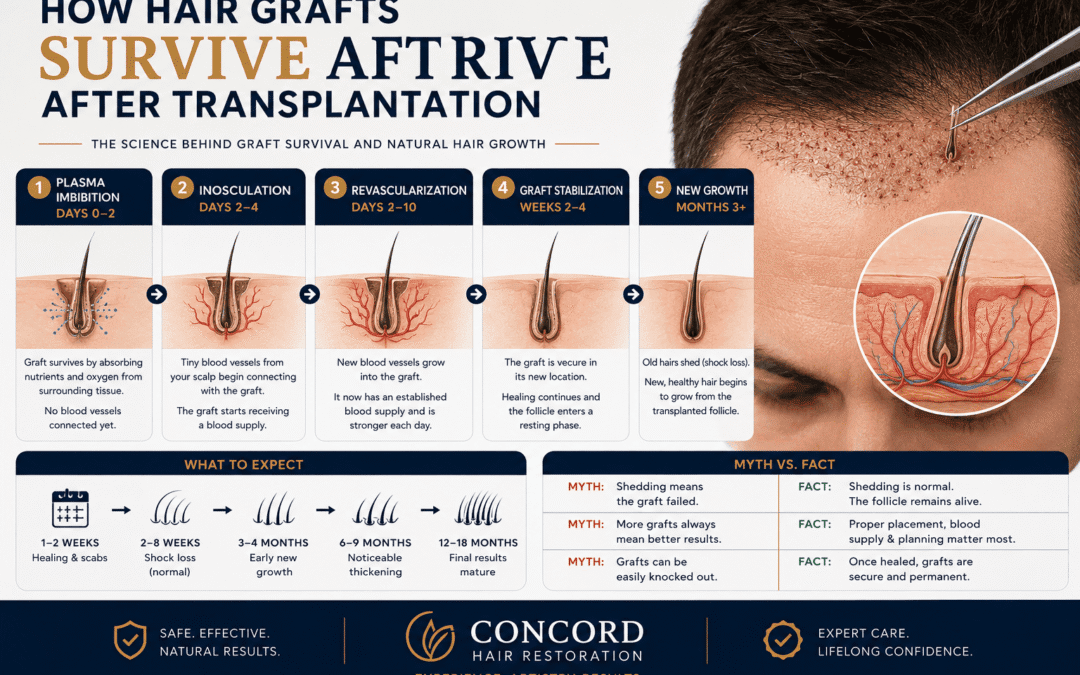
Phase 1: Plasma Imbibition (Days 0–2)
The first stage of graft survival is called plasma imbibition.
During this phase:
- No direct blood vessels exist yet
- The graft absorbs nutrients from surrounding tissue
- Oxygen diffuses into the follicle
- Cells remain alive while healing begins
This is why avoiding trauma during the first couple of days is so important.
The graft is stable inside the recipient site but still beginning its healing process.
Phase 2: Inosculation (Days 2–4)
Around the second or third day, something remarkable begins to happen.
Tiny blood vessels from your scalp start connecting with the transplanted follicle.
This process is called inosculation.
Instead of surviving through diffusion alone, the graft starts receiving its own blood supply again.
These microscopic vascular connections continue strengthening over the following days.
Phase 3: Revascularization (Days 4–10)
This is the stage most patients never hear about.
New capillaries actually grow into each transplanted graft.
This process is known as revascularization.
The follicle now begins functioning much like it did before transplantation.
Blood delivers:
- Oxygen
- Nutrients
- Growth factors
- Immune cells
- Hormones
Once revascularization is complete, graft survival increases dramatically.
Why Blood Supply Is Everything
Healthy follicles require constant circulation.
Blood provides:
- Oxygen for cell metabolism
- Amino acids for growth
- Vitamins
- Hormones
- Healing factors
Without adequate circulation, follicles cannot remain healthy.
That’s one reason experienced surgeons focus on proper graft spacing.
Placing too many grafts into a very small area may temporarily compete for available blood supply.
Proper planning helps maximize long-term density.
What Is Shock Loss?
One of the most misunderstood parts of recovery is shock loss.
Patients often panic when transplanted hairs begin falling out.
This is expected.
Shock loss occurs because the follicle temporarily enters its resting phase after surgery.
Importantly:
The hair falls out.
The follicle remains alive underneath the skin.
Several months later, new hairs begin growing from those same follicles.
If you’d like to learn more, read our guide on Shock Loss After Hair Transplant Surgery.
Does Losing Hair Mean the Graft Failed?
No.
This is probably the biggest misconception online.
Hair shedding does not mean the graft died.
In most successful transplants:
- Hair sheds.
- Follicle survives.
- New growth begins later.
The transplanted root remains safely beneath the skin.
When Are Hair Grafts Secure?
Patients frequently ask:
“When can I accidentally knock one out?”
Generally speaking:
First 48 Hours
Handle the scalp very carefully.
Days 3–5
Healing continues.
Scabs begin forming.
Around Day 7
Most grafts are becoming much more secure.
Days 10–14
Most grafts are firmly anchored within the scalp.
Normal gentle washing usually resumes around this time according to your surgeon’s instructions.
What Percentage of Hair Grafts Survive?
Modern FUE hair transplant techniques performed by experienced surgical teams often achieve very high graft survival rates.
While results vary between patients, factors that influence survival include:
- Surgical technique
- Time grafts remain outside the body
- Proper hydration
- Gentle handling
- Healthy recipient blood supply
- Patient aftercare
- Smoking status
- Overall health
High graft survival is one reason technique matters far more than simply transplanting a large number of follicles.
What Can Reduce Graft Survival?
Several factors can negatively affect outcomes.
These include:
- Smoking
- Poor circulation
- Infection
- Excessive trauma
- Picking scabs
- Poor surgical technique
- Improper graft storage
- Severe dehydration of follicles
Choosing an experienced hair restoration practice is one of the most important decisions you’ll make.
Does Sleeping Wrong Kill Grafts?
Usually, no.
Patients often become extremely anxious about sleeping positions.
During the first few nights, your surgeon may recommend sleeping with your head elevated to reduce swelling.
The primary concern isn’t crushing follicles.
It’s minimizing swelling while protecting the newly transplanted area.
Can Washing Your Hair Damage Grafts?
Gentle washing is actually part of proper recovery.
Following your clinic’s instructions helps:
- Remove crusting
- Reduce bacteria
- Promote healing
- Keep follicles clean
Aggressive scrubbing should be avoided early in recovery, but proper cleansing supports healthy healing.
How Long Until Hair Starts Growing?
The timeline surprises many patients.
Weeks 1–2
Healing.
Weeks 2–8
Shock loss.
Months 3–4
Early regrowth begins.
Months 5–8
Noticeable improvement.
Months 9–12
Significant density develops.
12–18 Months
Final maturation.
If you’re interested in a more detailed breakdown, see our Hair Transplant Recovery Timeline
Myth vs. Fact
Myth:
“If transplanted hair falls out, the surgery failed.”
Fact:
Hair shedding is expected. The follicle remains alive.
Myth:
“Touching your scalp ruins every graft.”
Fact:
Normal, gentle contact after the initial healing period typically does not damage established grafts.
Myth:
“The more grafts transplanted, the better.”
Fact:
Healthy blood supply and proper planning matter more than simply increasing graft count.
Myth:
“Hair grows immediately.”
Fact:
Most patients begin seeing meaningful growth several months after surgery.
The Bottom Line
Hair transplantation isn’t simply about moving hair from one part of the scalp to another.
It’s about preserving thousands of living follicles while allowing each one to reconnect with your body’s blood supply and begin growing naturally again.
Understanding plasma imbibition, revascularization, and shock loss helps explain why patience is such an important part of the recovery process.
At Concord Hair Restoration, every treatment plan is designed around creating healthy graft survival, natural-looking density, and long-term results. If you’re considering hair transplant surgery in Los Angeles, or would like to schedule a consultation in San Diego, our team can help you understand what to expect before, during, and after your procedure.
Frequently Asked Questions About Hair Graft Survival
How do transplanted hair grafts survive after surgery?
Immediately after transplantation, hair grafts receive oxygen and nutrients through a process called plasma imbibition. Within a few days, tiny blood vessels begin reconnecting to the follicles through inosculation and revascularization, allowing the grafts to establish their own permanent blood supply.
What is plasma imbibition?
Plasma imbibition is the first stage of graft survival. During the first 24 to 48 hours after a hair transplant, transplanted follicles absorb nutrients and oxygen from the surrounding tissue before new blood vessels develop.
When do hair grafts develop a new blood supply?
New blood vessel connections typically begin forming within two to four days after surgery. Revascularization continues over the first week, helping transplanted follicles receive oxygen and nutrients needed for long-term survival.
What is shock loss after a hair transplant?
Shock loss is a normal part of recovery in which transplanted hairs temporarily shed a few weeks after surgery. Although the hair shaft falls out, the follicle remains alive beneath the scalp and will usually begin producing new hair several months later.
Does shedding mean my hair transplant failed?
No. Shedding is an expected part of the healing process. Most transplanted follicles remain healthy beneath the skin and enter a temporary resting phase before new growth begins.
When are hair grafts securely attached?
Most grafts become increasingly secure during the first week after surgery and are generally well anchored by approximately 10 to 14 days. Your surgeon will provide specific instructions regarding washing and activity during this healing period.
Can I accidentally knock out a hair graft?
During the first few days after surgery, newly transplanted grafts should be protected from unnecessary trauma. After the initial healing period, grafts become much more secure and are less likely to be displaced during normal daily activities.
Does smoking affect graft survival?
Yes. Smoking may reduce blood flow and oxygen delivery to healing tissues, which can negatively affect recovery and potentially reduce graft survival. Patients are often encouraged to avoid smoking before and after surgery.
What factors influence hair graft survival?
Several factors contribute to successful graft survival, including surgical technique, gentle graft handling, proper hydration, healthy blood circulation, patient aftercare, and following post-operative instructions.
How long does it take for transplanted hair to grow?
Most patients begin seeing early hair growth around three to four months after surgery. Significant improvement usually occurs between six and nine months, with final results continuing to mature for up to 12 to 18 months.
Does washing my hair damage transplanted grafts?
When performed according to your surgeon’s instructions, gentle washing is an important part of recovery. Proper cleansing helps remove crusts, reduces bacteria, and supports healthy healing without damaging established grafts.
What is the difference between hair shedding and graft failure?
Hair shedding involves the temporary loss of the transplanted hair shaft while the follicle remains alive beneath the skin. Graft failure occurs when the follicle does not survive. Fortunately, with modern FUE techniques and proper aftercare, graft survival rates are typically very high.