
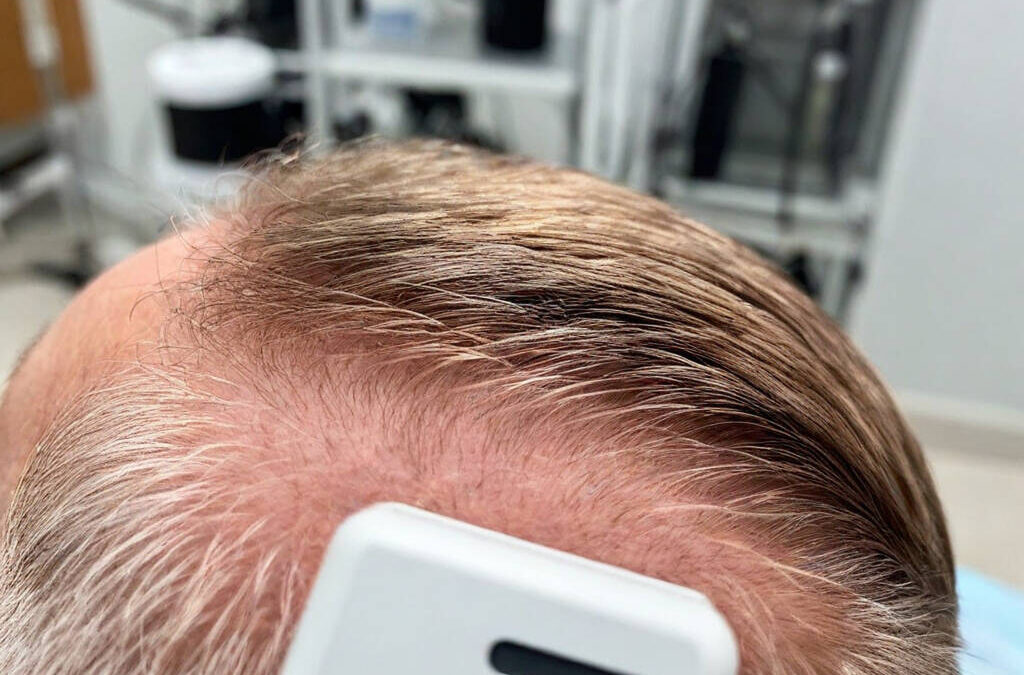
Hair restoration has changed dramatically over the past several decades.
Older hair transplant procedures were often associated with large grafts, noticeable “hair plugs,” and more visible scarring. Modern techniques allow individual follicular units to be transplanted with much greater control over hairline design, direction, angle, and density. These advances have made natural-looking hair transplant results much more achievable for appropriately selected patients. American Academy of Dermatology
But modern FUE is probably not the end of the story.
Researchers are now studying technologies that could eventually change not only how follicles are transplanted, but whether new follicles can someday be regenerated, multiplied, or bioengineered.
At Concord Hair Restoration, we think it is important to separate hair restoration technology available today from experimental technology that is still being studied.
How Hair Transplants Work Today
Modern hair transplantation still relies primarily on moving healthy follicles from one part of the scalp to another.
Hair is generally harvested from an appropriate donor region along the back or sides of the scalp and transplanted into areas affected by thinning or baldness.
This means today’s hair transplant does not create an unlimited supply of new follicles.
The patient’s existing donor hair remains one of the most important factors determining how much restoration may realistically be possible.
Patients who want to understand this limitation in more detail can read our guide to donor hair and hair transplant donor areas.
The American Academy of Dermatology similarly identifies having enough healthy donor hair as one of the basic requirements for hair-transplant candidacy. American Academy of Dermatology
FUE Continues to Shape Modern Hair Restoration
Follicular Unit Extraction, commonly called FUE, remains one of the most important advances in surgical hair restoration.
Rather than removing a strip of donor tissue, FUE allows individual follicular units to be harvested from the donor region.
This provides greater flexibility in distributing extractions and eliminates the long linear donor scar associated with traditional strip harvesting.
However, FUE should not be described as scarless.
Each extraction creates a small wound, and careful donor management is still necessary to prevent visible thinning or overharvesting.
Patients who want a complete explanation can read our FUE hair transplant guide.
Automated FUE Technology
Automation has also changed portions of the FUE process.
NeoGraft is an example of technology that assists with follicular-unit extraction and implantation.
It is important, however, not to confuse automated FUE with fully robotic hair transplantation.
NeoGraft does not independently design a hairline, determine how many grafts should be used, predict a patient’s lifetime hair-loss pattern, or decide exactly where every follicular unit belongs.
Those decisions still require clinical and aesthetic judgment.
Learn more about the technology Concord uses on our NeoGraft hair transplant page.
What About Robotic Hair Transplants?
Robotic systems are another development in FUE hair restoration.
Some systems can assist with identifying or extracting follicular units from the donor area.
That does not mean a robot performs the entire hair transplant independently.
Hair transplantation involves much more than removing follicles.
The treatment plan must consider donor supply, future hair loss, hairline position, density, graft distribution, angle, direction, and how the result is likely to age over time.
Robotic assistance may help with certain technical portions of a procedure, but the technology itself does not guarantee a natural result.
We explain that distinction in our guide to robotic hair transplants vs. automated FUE.
Artificial Intelligence and Hair Restoration
Artificial intelligence will likely become increasingly useful in hair restoration, particularly as an analytical and planning tool.
For example, advanced software may help clinicians evaluate scalp images, measure density, identify patterns of thinning, document progression, compare photographs, and improve treatment simulations.
The key word is assist.
AI cannot replace an appropriate medical evaluation or the judgment required to determine whether someone is actually a good candidate for transplantation.
It also cannot turn hairline design into a simple mathematical formula.
A believable hairline still depends on factors such as facial proportions, age, existing hair, graft selection, irregularity, angle, direction, and future hair loss.
Our guide to natural hairline design for hair transplants explains why those details matter.
The Biggest Challenge: Donor Hair Is Limited
Perhaps the most exciting area of future hair restoration research involves solving one fundamental limitation of modern transplantation:
The donor supply is finite.
A transplant redistributes follicles. It does not duplicate them.
Once a follicular unit has been removed from one location and transplanted somewhere else, it no longer contributes density to its original donor area.
This is why responsible donor management matters so much.
Patients considering FUE should understand hair transplant donor-area management and overharvesting before focusing only on how many grafts can be harvested.
Future regenerative technologies could potentially change this limitation.
Is Hair Cloning Real?
The phrase hair cloning gets a lot of attention online.
The basic concept is appealing: instead of being limited to the follicles naturally available in the donor area, scientists would use cells from existing follicles to generate additional hair-producing structures.
If that could eventually be done safely, reliably, and at scale, it could dramatically change hair restoration.
Patients with limited donor hair might theoretically have access to a much larger supply of follicles.
But this is not a routine clinical treatment today.
A functioning hair follicle is a complex miniature organ. Researchers need to reproduce not only a structure capable of producing a hair shaft, but a follicle capable of integrating with surrounding skin and repeating normal hair-growth cycles.
That remains a major scientific challenge.
Hair Follicle Organoids
One promising research area involves hair follicle organoids.
Organoids are three-dimensional structures grown from cells in ways that mimic certain features of natural biological tissue.
Researchers are studying hair-follicle organoids to better understand how follicles develop, communicate with surrounding cells, and regenerate.
A 2026 review describes meaningful progress in creating hair-follicle organoid models but also identifies important challenges, including maturity, standardization, and the difficulty of translating laboratory models into scalable human treatments. PubMed Central (PMC)
For patients, the important takeaway is simple:
Scientists are learning how to recreate increasingly sophisticated follicle-like structures, but this is not the same as having an unlimited supply of transplant-ready human hair follicles available at a clinic.
Stem Cells and Hair Regeneration
Stem-cell research is closely connected to the future of follicle regeneration.
Hair follicles naturally contain specialized cell populations that help regulate the hair-growth cycle.
Researchers are studying whether these cells, dermal papilla cells, induced pluripotent stem cells, and related technologies could eventually help regenerate functional follicles.
The potential is exciting.
However, patients should be careful with the phrase “stem cell hair transplant.”
Experimental research involving follicle regeneration should not be confused with an established treatment proven to manufacture unlimited replacement follicles.
For patients interested in treatments currently available for existing thinning hair, Concord also provides information about hair regrowth therapy in California.
3D Bioprinting and Hair Follicles
Another area attracting research attention is 3D bioprinting.
This is much more complex than simply “printing hair.”
Researchers are investigating ways to use cells, biological materials, scaffolds, and engineered tissue to recreate the environment necessary for a functional follicle to develop.
A major 2026 review describes progress involving dermal papilla spheroids, follicle organoids, engineered tissue, and bioprinted skin containing early follicle-like structures.
But the same review highlights major challenges, including blood-vessel integration, nerve integration, and recreating normal hair-growth cycling. PubMed Central (PMC)
That means bioprinting is scientifically promising, but it remains very different from an established hair transplant procedure available today.
Why Blood Supply Matters
Creating something that resembles a follicle in a laboratory is only part of the problem.
A functional follicle also needs to survive after transplantation.
It must integrate into living tissue and receive an adequate blood supply.
Today’s transplanted follicles depend on the recipient scalp’s healing process and vascular supply to survive and eventually produce new hair.
The same fundamental biological requirement would apply to an engineered follicle.
This is one reason regenerative hair restoration remains such a complex field.
New Follicles Would Also Need to Cycle Normally
Human hair follicles do not simply grow one hair forever.
They repeatedly pass through growth, transition, and resting phases.
An engineered follicle would therefore need to do more than produce a single hair shaft.
It would need to behave like a functioning human follicle over time.
That includes growing hair, resting, shedding, and beginning another growth cycle.
Successfully reproducing that long-term behavior is one of the major hurdles between laboratory hair-follicle research and a practical treatment for patients.
Could Future Technology Eliminate Donor Limitations?
This is one of the most intriguing possibilities.
Today’s hair transplant planning is largely about using a limited resource intelligently.
A patient with extensive baldness may want far more density than the donor area can safely provide.
That is why we often emphasize that the goal should not simply be extracting the largest possible number of grafts.
You can learn more in our guide to how many hair transplant grafts you may need.
If scientists eventually develop a safe and reliable way to multiply or regenerate healthy follicles, donor limitations could become far less restrictive.
Instead of asking:
“How many follicles can we safely harvest?”
Hair restoration specialists might someday ask:
“How many follicles can we generate?”
That would represent one of the biggest changes in the history of hair transplantation.
But it remains a future possibility, not something patients should expect from a hair transplant today.
The Future May Be About Preserving Hair Earlier
Not every advancement will involve futuristic surgery.
Some of the most useful developments may come from identifying hair loss earlier and preserving existing follicles more effectively.
Better imaging and data analysis could help track miniaturization before hair loss becomes obvious.
This could potentially help clinicians understand which areas are changing, how quickly loss is progressing, and whether surgery should be performed now or delayed.
That matters because a hair transplant does not automatically prevent the patient’s remaining natural hair from thinning later.
Our article about continued hair loss after a hair transplant explains why long-term planning is so important.
Better Technology Does Not Automatically Mean a Better Hair Transplant
Patients are often attracted to clinics advertising the newest machine.
But technology is only one part of a successful result.
Even the most sophisticated extraction system cannot compensate for an unnatural hairline, excessive donor harvesting, poor graft distribution, incorrect direction, unrealistic density expectations, or failure to plan for future hair loss.
Modern hair restoration should therefore combine technology with careful planning.
Patients interested in how these factors affect the final appearance can read why some hair transplants look unnatural.
FUE vs. FUT Will Still Matter
Even as new technology develops, patients researching surgery today still need to understand the established transplant methods.
FUE harvests individual follicular units, while FUT removes a strip of donor tissue that is subsequently divided into follicular grafts.
Each approach has different considerations involving scarring, donor management, recovery, and future procedures.
Our FUE vs. FUT hair transplant comparison explains the differences in greater detail.
Will Hair Transplants Eventually Become Obsolete?
Probably not in the immediate future.
Current hair transplantation can already move established human follicles from a donor area into areas where additional coverage is needed.
Regenerative approaches are attempting to solve a much harder problem: reliably generating new functional follicles capable of surviving, integrating, and cycling normally.
It may be more realistic to imagine future technologies enhancing hair transplantation rather than suddenly replacing it.
Future patients could potentially benefit from a combination of more precise imaging, better preservation of existing hair, improved FUE tools, AI-assisted planning, regenerative treatments, and eventually bioengineered follicles.
Be Careful With Futuristic Hair Restoration Claims
As research progresses, marketing will probably progress even faster.
Patients should be cautious when they encounter claims such as “scarless hair transplant,” “unlimited donor hair,” “hair cloning available now,” “AI-guaranteed results,” or “100% graft survival.”
A useful question is:
Is this technology actually available as an established treatment, or is someone describing experimental research as though it were already routine medicine?
That distinction can prevent unrealistic expectations.
What Does This Mean If You Want a Hair Transplant Today?
You do not necessarily need to postpone an appropriate hair transplant because researchers may develop better regenerative technologies someday.
There is no reliable date when hair cloning, mass follicle multiplication, or bioengineered follicles will become routine clinical treatments.
Patients considering surgery today should make decisions based on the technologies and evidence available now.
That includes evaluating donor supply, hair-loss progression, realistic density, hairline design, and the possibility of future procedures.
Patients considering treatment in Southern California can explore our FUE hair transplant options in Los Angeles.
For a broader overview of treatment and consultation options, visit our Los Angeles hair transplant clinic guide.
You can also see examples of treatment outcomes in our hair transplant before-and-after gallery.
The Future of Hair Restoration Is Promising
Hair restoration is moving beyond simply improving surgical instruments.
Researchers are studying whether follicles themselves can eventually be regenerated, multiplied, engineered, or recreated using technologies such as stem cells, organoids, tissue engineering, and 3D bioprinting.
That research is exciting.
But today’s fundamentals still matter:
Good patient selection. Responsible donor management. Thoughtful hairline design. Careful graft placement. Realistic density. And long-term planning.
Future technology should make those fundamentals better—not replace them.
Frequently Asked Questions
Is hair cloning available now?
No. Hair follicle multiplication and regeneration are active areas of research, but hair cloning is not currently a routine clinical alternative to FUE transplantation.
Can scientists grow hair follicles in a laboratory?
Researchers have developed increasingly sophisticated follicle-like structures and organoids. Turning those discoveries into large numbers of reliable, transplantable human follicles remains an active research challenge. PubMed Central (PMC)
Can stem cells regrow an unlimited amount of hair?
Not with an established clinical treatment available today. Stem cells are an important part of regenerative hair research, but patients should be skeptical of claims that current treatments can manufacture unlimited replacement follicles.
Can hair follicles be 3D printed?
Researchers are studying 3D bioprinting and engineered tissue containing follicle-like structures, but this remains experimental rather than a standard clinical hair-restoration procedure. PubMed Central (PMC)
Will AI perform hair transplants?
AI is more likely to assist with imaging, measurements, documentation, simulations, and treatment planning than independently replace the clinical and aesthetic judgment required for transplantation.
Should I wait for hair cloning before having a transplant?
There is no dependable timeline for routine commercial hair cloning. Someone considering treatment should evaluate current options based on their individual hair-loss pattern, donor supply, candidacy, and goals.