
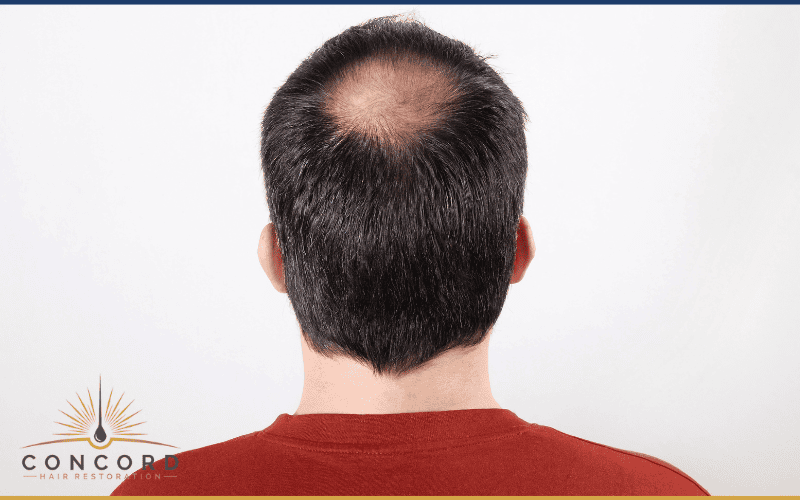
Crown hair loss can be one of the most frustrating types of thinning because it often spreads gradually and can involve a surprisingly large area of the scalp.
For patients considering a crown hair transplant, one of the first questions is usually:
How many grafts will I need?
There is no single answer that applies to everyone.
The number of grafts needed for crown restoration depends on the size of the thinning area, existing hair, donor density, hair caliber, the natural crown pattern, and how much donor hair should be preserved for the future.
The crown also behaves differently from the frontal hairline, which is why treatment planning requires a different strategy.
What Is the Crown Area?
The crown, also called the vertex, is the area near the back and top of the scalp where hair often grows in a circular or spiral pattern.
In people with pattern hair loss, the crown may gradually become thinner until more scalp is visible.
Some patients experience isolated crown thinning, while others develop hair loss across several areas, including:
- The frontal hairline
- Temples
- Mid-scalp
- Crown
When several areas are affected, the treatment plan must consider where available donor grafts will create the most meaningful improvement.
Why Crown Hair Transplants Are Different
The crown is not simply a flat, circular area that needs to be filled with hair.
Natural crown hair typically grows in a whorl pattern, with hairs changing direction as they move around the center of the crown.
That makes graft placement especially important.
A crown transplant may require careful planning of:
- Hair direction
- Hair angles
- Graft distribution
- Existing native hair
- Natural whorl pattern
- Density transitions
The objective is to restore coverage while creating a growth pattern that blends naturally with the surrounding hair.
How Many Grafts Are Needed for a Crown Hair Transplant?
There is no universal graft number for crown restoration.
As a general planning range, Concord Hair Restoration’s existing graft guide notes that crown restoration may involve approximately 1,500 to 3,500 grafts, depending on the size and characteristics of the treatment area. Pasted markdown
Some patients may need fewer grafts if the crown area is relatively small or still contains substantial native hair.
Others may require more extensive planning if the thinning area is large.
The graft number can be influenced by several factors.
1. Size of the Crown
A small area of early crown thinning requires a very different treatment plan from a large area of advanced hair loss.
As the treatment area expands, more grafts are generally required to create visible coverage.
However, the goal is not necessarily to transplant the maximum number possible.
The recommendation should also consider donor supply and future hair-loss progression.
2. Existing Hair Density
A crown that still contains a significant amount of native hair may require fewer grafts than an area with very little remaining hair.
Existing hair can contribute to visual coverage.
A physician also has to consider whether some of that native hair may continue thinning in the future.
That is one reason crown planning should not be based only on what the scalp looks like today.
3. Hair Caliber
Hair thickness can affect how much coverage a given number of grafts creates.
Coarser hair can often produce more visual coverage than very fine hair.
This means two patients receiving the same number of grafts may have very different-looking results.
4. Hair Texture
Hair texture can also influence the appearance of density.
Curly or wavy hair may create more visual coverage than very straight hair.
These characteristics are considered when estimating how many grafts may be needed.
5. Donor Area Quality
Every hair transplant depends on the available donor supply.
The donor area usually includes hair from the back and sides of the scalp that may be more resistant to common pattern hair loss.
But donor hair is limited.
A crown hair transplant must therefore balance the desire for more density with responsible preservation of donor follicles.
You can learn more about this in our guide to donor area management and overharvesting.
Why the Crown Can Use a Lot of Grafts
Patients are sometimes surprised by how many grafts the crown can require.
The reason is partly geometric.
The crown can involve a broad circular area, and follicles need to be distributed in a way that creates coverage while respecting the natural whorl pattern.
Attempting to create very high density across a large crown can consume a substantial portion of the donor supply.
That is why crown restoration is often about creating the best visual improvement possible with the available grafts rather than trying to recreate the exact density someone had before hair loss began.
Crown Density vs. Hairline Density
The crown and frontal hairline often have different cosmetic priorities.
The frontal hairline frames the face and is visible from the front.
The crown is typically viewed from above and behind.
For patients with both frontal and crown hair loss, the frontal area may sometimes receive greater priority because of its impact on facial appearance.
That does not mean the crown is unimportant.
It means treatment planning has to consider how to distribute a limited donor supply across multiple areas.
Our guide to hair transplant density explains why density is about more than simply placing as many grafts as possible.
Should the Hairline or Crown Be Treated First?
There is no universal rule.
The answer depends on:
- Degree of hair loss
- Donor availability
- Patient priorities
- Age
- Existing native hair
- Expected future hair loss
- Size of each treatment area
For some patients, restoring the frontal hairline first may create the greatest visual improvement.
For others, the crown may be the area that bothers them most.
In some cases, both areas may be treated in the same procedure if donor supply and graft requirements allow.
The right plan should be individualized.
Can the Crown and Hairline Be Transplanted at the Same Time?
Yes, in some cases.
A patient with enough donor hair may be able to treat both the frontal region and crown during one procedure.
However, doing so can require a large number of grafts.
If the donor supply is limited, attempting to treat too much area at once may spread grafts too thinly or reduce options for future procedures.
That is why long-term planning matters.
Why More Crown Grafts Are Not Always Better
A larger graft number does not automatically produce a better result.
Using too many donor follicles in one area can reduce the number available for other areas later.
This can become important if hair loss continues around the transplant.
A good treatment plan considers:
- Current crown loss
- Future crown expansion
- Frontal hairline needs
- Mid-scalp thinning
- Donor preservation
- Potential future procedures
The goal is not simply maximum graft use.
It is strategic graft use.
If you want a broader explanation of graft planning, read How Many Hair Grafts Do I Need?.
How FUE Is Used for Crown Restoration
FUE, or Follicular Unit Extraction, is commonly used for crown hair transplantation.
During FUE, individual follicular units are removed from the donor area and placed into the treatment area.
For crown restoration, careful placement is especially important because the grafts need to follow the direction of the natural crown pattern.
The technique can also allow grafts to be distributed strategically across thinning areas.
Learn more about the procedure in our FUE Hair Transplant Los Angeles guide.
What Makes a Crown Hair Transplant Look Natural?
A natural-looking crown transplant depends on several factors working together.
These may include:
- Accurate recreation of the natural whorl
- Appropriate graft direction
- Proper hair angles
- Gradual density transitions
- Blending with existing hair
- Responsible graft distribution
- Consideration of future hair loss
The placement pattern can be just as important as the total graft count.
A high number of grafts placed without attention to direction and distribution may still produce an unnatural result.
How Long Does Crown Hair Transplant Growth Take?
Hair transplant growth develops gradually.
Immediately after surgery, the focus is on healing.
Transplanted hairs may later shed while the follicles remain beneath the skin.
New growth generally develops over the following months.
The crown can take time to mature, and final appearance should not be judged during the early stages of recovery.
For a month-by-month overview, visit our hair transplant timeline.
Does the Crown Grow More Slowly Than the Hairline?
Patients sometimes notice that the crown appears to mature differently from the frontal area.
That can happen because the crown is a larger, more complex area with a different visual growth pattern.
The exact timeline varies from patient to patient.
Rather than comparing one area directly with another, it is more useful to evaluate the overall progression over time.
Can Crown Hair Loss Continue After a Transplant?
Yes.
A hair transplant relocates donor follicles, but untreated native hair surrounding the transplanted area may continue to thin.
That can affect the appearance of the crown over time.
This is another reason long-term planning is important.
A treatment plan should consider not only the current bald or thinning area but also how the pattern may progress.
Can You Have a Second Crown Hair Transplant?
Possibly.
Some patients consider a second procedure if:
- Hair loss continues
- They want additional density
- The original treatment covered only part of the crown
- Additional donor hair remains available
Whether another procedure is appropriate depends on the donor area, existing results, and future hair-loss pattern.
This is why donor preservation during the first procedure can matter later.
What If You Have Both Crown and Mid-Scalp Thinning?
When the crown and mid-scalp are both affected, the total treatment area becomes much larger.
That can significantly increase graft requirements.
In this situation, the plan may involve prioritizing specific areas or staging treatment over time.
Attempting to create maximum density across every thinning area in a single procedure may not always be the best use of the donor supply.
How Is Crown Graft Count Estimated?
During a consultation, the treatment team may evaluate:
- Size of the crown
- Existing hair density
- Hair caliber
- Hair texture
- Natural whorl pattern
- Donor density
- Other areas of hair loss
- Future progression
- Treatment goals
The recommendation should explain not only how many grafts may be appropriate, but why that number makes sense.
Frequently Asked Questions About Crown Hair Transplants
How many grafts are usually needed for the crown?
There is no single number that applies to every patient. A general planning range may be approximately 1,500 to 3,500 grafts, but the actual number depends on the size of the crown, existing hair, donor supply, hair characteristics, and long-term treatment plan.
Is 2,000 grafts enough for the crown?
For some patients, 2,000 grafts may provide meaningful improvement. For others with a larger treatment area, that number may not provide the desired level of coverage. An evaluation is needed to estimate what is realistic.
Is 3,000 grafts enough for a crown transplant?
It may be for some patients, but graft requirements depend on the size of the area and the density being planned.
Can a crown hair transplant look natural?
Yes, natural-looking results may be possible when grafts are placed with attention to the crown’s natural whorl, hair direction, density transitions, and existing hair.
Does a crown hair transplant take longer to grow?
Growth timelines vary between patients. Crown results can take time to mature and should be evaluated over several months rather than during early recovery.
Should I restore my crown or hairline first?
There is no universal answer. The decision depends on your pattern of hair loss, donor supply, treatment goals, and the visual impact of each area.
Can the crown be transplanted with FUE?
Yes. FUE can be used to harvest individual follicular units for crown restoration.
Can crown hair loss continue after surgery?
Yes. Native hair around the transplanted follicles may continue thinning over time, so long-term planning is important.
Considering a Crown Hair Transplant?
Crown restoration requires more than choosing a graft number.
The treatment plan should account for the size of the crown, natural whorl pattern, existing hair, donor supply, future hair loss, and how grafts should be distributed for the most natural-looking result.
Concord Hair Restoration provides personalized hair transplant planning from its Encino office for patients throughout Los Angeles and surrounding communities.
If you’re considering crown restoration and want to understand how many grafts may be appropriate, schedule a personalized consultation.
Concord Hair Restoration – Encino
16661 Ventura Blvd., Suite 703
Encino, CA 91436
(818) 800-2002