Hair Transplant Oceanside, CA: FUE Hair Restoration Near Oceanside
Private FUE by Concord Hair Restoration
If you’re researching a hair transplant in Oceanside, CA, choosing the right treatment plan matters more than simply choosing the closest office.
Concord Hair Restoration serves patients from Oceanside, North County San Diego, and surrounding communities from our San Diego hair restoration office. Our approach focuses on personalized treatment planning, natural-looking hairline design, careful donor management, and realistic long-term results.
Whether you are concerned about a receding hairline, thinning crown, widening part, patchy beard growth, thinning edges, or previous hair transplant results, the first step is understanding why you are losing hair and what can realistically be restored.
Concord Hair Restoration does not have a physical office in Oceanside. Oceanside patients are seen at our San Diego location at 7801 Mission Center Ct., Suite 105, San Diego, CA 92108. Concord Hair Restoration
Patients who want a broader overview of our San Diego services can also visit our San Diego hair restoration page.

Hair Restoration for Oceanside and North County Patients
Living in Oceanside gives patients access to hair restoration options throughout San Diego County, but hair transplantation is not a procedure that should be chosen based on distance alone.
A successful treatment plan should consider factors such as:
- The cause of your hair loss
- Your current hair-loss pattern
- Donor hair availability
- Hair density and caliber
- Age and facial proportions
- Future hair-loss progression
- Previous hair restoration procedures
- Desired density
- Hairstyle preferences
- Long-term treatment goals
At Concord Hair Restoration, the goal is not simply to transplant the largest possible number of grafts.
The goal is to create a balanced result that makes appropriate use of your available donor hair and continues to look natural as your hair changes over time.
FUE Hair Transplants Near Oceanside
Follicular Unit Extraction, commonly called FUE, is one of the primary techniques used in modern surgical hair restoration.
During FUE, individual follicular units are harvested from an appropriate donor area, usually from portions of the back and sides of the scalp.
Those follicles are then placed into areas where additional coverage is desired.
Unlike FUT strip harvesting, FUE does not require removing a long strip of donor tissue.
Potential advantages may include:
- No long linear donor scar
- Individual follicular-unit harvesting
- Flexible graft placement
- Natural-looking hairline design
- Greater flexibility with shorter hairstyles
- Customized donor management
However, FUE is not truly “scarless.”
Each extraction creates a small healing site, which is why donor planning and extraction spacing are important.
Patients who want to understand the procedure in greater detail can read our complete FUE hair transplant guide.
NeoGraft FUE Hair Restoration
Concord Hair Restoration also uses NeoGraft technology to assist with portions of the FUE process.
NeoGraft is an automated FUE system that can assist with follicular-unit extraction and implantation.
The technology itself does not decide:
- Where your hairline should be placed
- How many grafts should be used
- Which areas should receive the greatest density
- How much donor hair should be preserved
- How future hair loss should be planned for
Those decisions still require individualized evaluation and careful treatment planning.
Learn more about NeoGraft FUE hair transplantation.
Why Your Donor Area Matters
Patients often focus on the area where they want more hair.
But in many cases, the donor area determines what is actually possible.
Hair transplantation redistributes existing follicles.
It does not create an unlimited supply of new donor hair.
That means every graft used in the frontal hairline, temples, mid-scalp, or crown comes from a limited biological resource.
A donor evaluation may consider:
- Donor density
- Hair caliber
- Follicular-unit characteristics
- Miniaturization
- Previous procedures
- Scalp condition
- Expected future hair loss
Our guide to understanding donor hair and your hair transplant donor area explains why donor quality is such an important part of hair transplant planning.
Avoiding Donor Overharvesting
One of the biggest mistakes in FUE planning is focusing only on how many grafts can be removed.
Taking too many follicles from a limited donor area can create:
- Visible thinning
- Uneven density
- Patchiness
- Increased scalp visibility
- Reduced options for future procedures
This becomes particularly important for younger patients or anyone whose hair loss may continue over time.
A responsible hair transplant plan asks:
How many grafts can be used while still preserving a natural-looking donor area and future treatment options?
Read more about hair transplant donor-area management and overharvesting.
Natural Hairline Design
A natural-looking hair transplant is about much more than adding hair.
The hairline frames the face.
A believable hairline should be designed around the individual rather than created from the same template for every patient.
Important considerations can include:
- Facial proportions
- Age
- Existing hairline shape
- Temple recession
- Hair caliber
- Single-hair graft placement
- Hair direction
- Hair angle
- Irregularity
- Density transition
- Future hair loss
An overly straight or overly low hairline can become noticeable, especially as the patient ages.
Our guide to what makes a hair transplant hairline look natural explains these details in greater depth.
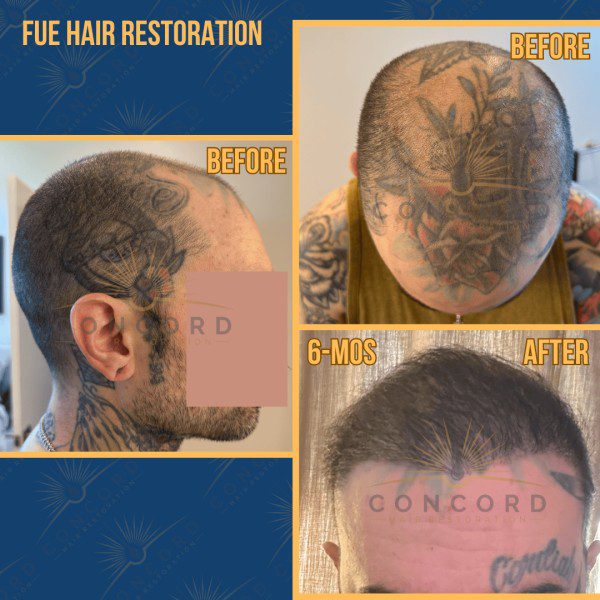
How Many Grafts Do Oceanside Hair Transplant Patients Need?
There is no standard graft count for a hair transplant.
Two patients with similar-looking hair loss may need very different treatment plans.
Graft requirements depend on factors such as:
- Size of the thinning area
- Hairline goals
- Donor supply
- Hair caliber
- Hair texture
- Curl
- Existing density
- Hair-to-scalp contrast
- Previous procedures
Someone seeking limited frontal reinforcement may need far fewer grafts than someone hoping to restore the hairline, mid-scalp, and crown.
For more information, read our guide to how many hair transplant grafts you may need.
Hair Transplant Density
Patients sometimes assume that the largest graft count automatically produces the best result.
That is not always true.
Hair transplant density depends on more than the number of follicular units placed.
Other factors include:
- Hair shaft thickness
- Follicular-unit size
- Curl
- Recipient-area size
- Existing hair
- Placement pattern
- Hair direction
- Donor limitations
Strategic placement can sometimes create a stronger visual result than simply attempting to maximize density everywhere.
Learn more about hair transplant density and realistic coverage.
Receding Hairline Restoration
A receding frontal hairline is one of the most common reasons people consider transplantation.
For appropriate candidates, FUE can be used to reinforce or reconstruct portions of the frontal hairline.
Hairline restoration requires careful planning because the front of the scalp is often the first thing other people notice.
Single-hair grafts, irregularity, angle, direction, and gradual density transitions all contribute to a natural appearance.
Crown Hair Restoration
Crown thinning presents a different challenge.
Hair in the crown grows in a whorl pattern, which means grafts must be placed according to the natural direction of surrounding hair.
The crown can also require a significant number of grafts.
For patients with more advanced hair loss, treatment planning may need to prioritize the frontal hairline and mid-scalp before committing a large portion of donor supply to the crown.
Hair Transplants for Women in Oceanside
Women can experience hair loss very differently from men.
Common concerns may include:
- Widening parts
- Diffuse thinning
- Hairline recession
- Traction alopecia
- Thinning edges
- Eyebrow loss
Not every form of female hair loss is best treated with transplantation.
The underlying cause should be evaluated first.
Patients can learn more in our hair transplant guide for women.
Beard and Facial Hair Restoration
Hair transplantation is not limited to the scalp.
Some patients seek FUE for:
- Patchy beard growth
- Sparse mustaches
- Facial scars
- Uneven facial hair
- Beard density enhancement
Facial-hair transplantation requires careful attention to direction and angle because beard hair naturally grows differently across different parts of the face.
Explore our FUE facial hair transplant options.
Eyebrow Hair Transplants
Eyebrow thinning may occur due to:
- Over-plucking
- Naturally sparse brows
- Scarring
- Aging
- Certain forms of hair loss
Eyebrow transplantation uses carefully selected donor follicles to add hair to sparse or missing areas.
Placement angle is especially important because natural eyebrow hairs grow relatively flat against the skin.
Learn more about eyebrow hair transplant procedures.
Will a Hair Transplant Stop Future Hair Loss?
No.
A transplant can move selected follicles into thinning areas, but it does not automatically stop surrounding native hair from continuing to change.
This is why long-term planning matters.
Treatment decisions may consider:
- Your age
- Family history
- Existing miniaturization
- Current hair-loss pattern
- Donor reserves
- Likelihood of future thinning
- Possible future procedures
Read our guide to continued hair loss after a hair transplant for a more detailed explanation.
Hair Transplant Recovery for Oceanside Patients
Recovery begins immediately after transplantation, but final growth develops gradually.
During early healing, patients may temporarily experience:
- Redness
- Small scabs
- Swelling
- Tenderness
- Shedding of transplanted hairs
The scalp may look healed long before the final cosmetic result appears.
For a month-by-month overview, read our hair transplant recovery and growth timeline.
Oceanside Sun, Beaches, and Hair Transplant Recovery
Living in Oceanside means easy access to the coast, sunshine, outdoor fitness, and year-round recreation.
That can also create some practical considerations during early hair transplant recovery.
Patients may temporarily need to modify activities involving:
- Prolonged direct sun exposure
- Heavy sweating
- Swimming
- Surfing
- Beach activities
- Tight hats
- Intense exercise
Oceanside Pier, Oceanside Harbor, South Oceanside, and the beach may be part of everyday life, but early recovery is generally a time to protect the healing scalp rather than rush back into prolonged outdoor activity.
Your treatment team will give you individualized instructions based on your procedure.
Our guide to hair transplant recovery in Southern California also explains how sun, heat, exercise, and outdoor activity can affect the early healing period.
Serving Downtown Oceanside, South Oceanside, Fire Mountain and North County
Concord Hair Restoration serves patients throughout North County San Diego, including those living in and around:
- Downtown Oceanside
- South Oceanside
- Fire Mountain
- Rancho Del Oro
- Oceanside Harbor
- North Valley
- Tri-City
- Carlsbad
- Vista
- San Marcos
- Encinitas
Oceanside patients are seen at Concord Hair Restoration’s San Diego office rather than at an Oceanside storefront.
This distinction is important because we want patients to know exactly where their consultation and treatment will take place.
Hair Transplant Clinic Serving Oceanside From San Diego
Our San Diego office is located at:
Concord Hair Restoration
7801 Mission Center Ct.
Suite 105
San Diego, CA 92108
(619) 905-4247 Concord Hair Restoration
Patients from Oceanside and North County travel to the San Diego location for consultations, treatment planning, procedures, and follow-up care.
What Happens During a Hair Transplant Consultation?
A consultation should answer more than one question.
It is not simply about deciding how many grafts someone can buy.
A consultation may evaluate:
- Hair-loss history
- Current pattern of thinning
- Donor density
- Miniaturization
- Hair caliber
- Facial proportions
- Previous procedures
- Hairline goals
- Future hair-loss risk
- Potential graft requirements
The goal is to determine whether transplantation is appropriate and what can realistically be achieved.
Patients can prepare by reading our guide to what to expect at your first hair transplant consultation.
How Much Does a Hair Transplant Near Oceanside Cost?
Hair transplant pricing varies because procedures are customized.
Factors may include:
- Number of grafts
- Size of the treatment area
- Complexity
- Previous procedures
- Donor characteristics
- Treatment plan
Someone needing limited hairline work may have a very different procedure from someone seeking broader restoration.
For general pricing information, visit our hair transplant cost guide.
Hair Transplant Financing
Concord Hair Restoration offers financing options for qualified patients who prefer to divide treatment costs into payments.
Financing approval and terms are determined by the financing provider.
Learn more about hair transplant payment plans.
Before and After Hair Transplant Results
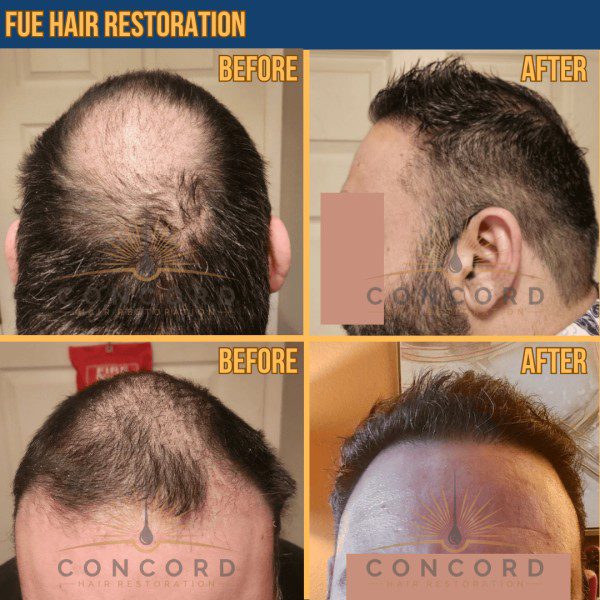
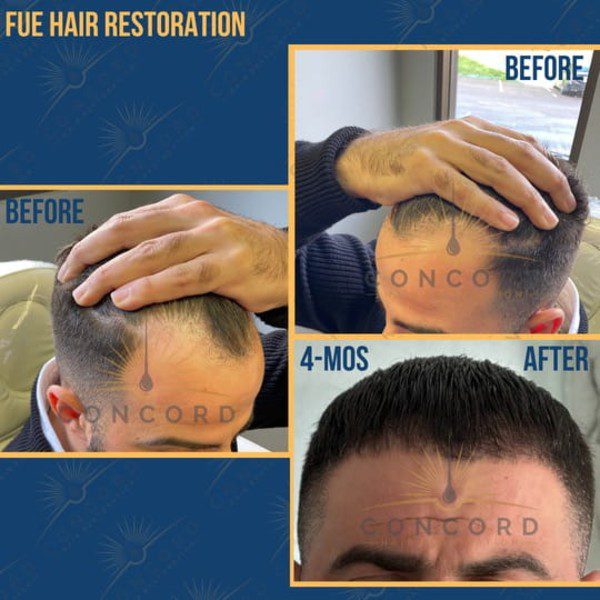
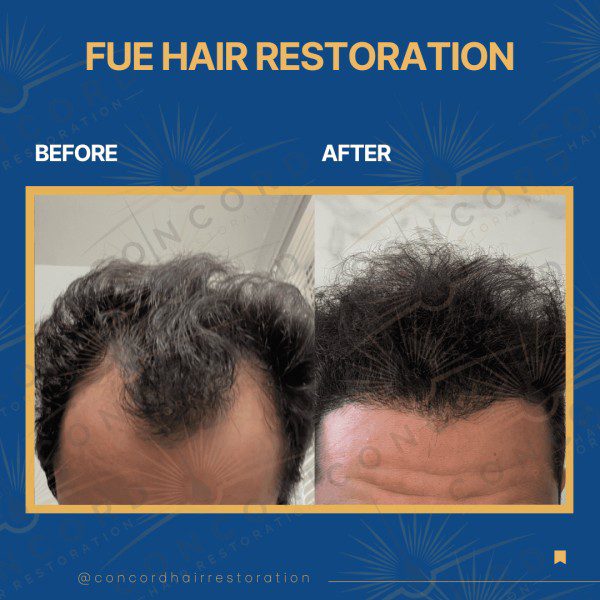
Before choosing a hair restoration provider, review actual patient results.
Look beyond overall density.
Pay attention to:
- Hairline shape
- Frontal softness
- Direction
- Angle
- Density transitions
- Crown patterns
- Donor appearance
You can view examples in the Concord Hair Restoration hair transplant before-and-after gallery.
Concord Hair Restoration – San Diego
7801 Mission Center Ct.
Suite 105
San Diego, CA 92108
(619) 905-4247
Contact Us Today to Schedule Your Consultation
Hair Transplant Oceanside FAQs
Does Concord Hair Restoration have an office in Oceanside?
No. Concord Hair Restoration serves Oceanside and North County patients from its San Diego office at 7801 Mission Center Ct., Suite 105, San Diego, CA 92108. Concord Hair Restoration
Where can Oceanside patients go for a hair transplant consultation?
Oceanside patients can schedule a consultation at Concord Hair Restoration’s San Diego office.
Is FUE available for Oceanside patients?
Yes. Concord Hair Restoration provides FUE hair transplantation for appropriate candidates at its San Diego location.
Does FUE leave scars?
FUE avoids the long linear scar associated with FUT strip harvesting, but it is not completely scarless. Each follicular-unit extraction produces a small healing site.
How many hair grafts will I need?
The number of grafts depends on the treatment area, donor density, hair characteristics, desired coverage, and long-term hair-loss pattern.
Can I go to the beach after a hair transplant?
Beach activities generally need to be limited during early recovery because of sun, wind, sand, swimming, and physical activity. Follow your individualized postoperative instructions before returning.
Can I surf after a hair transplant?
Not immediately. Surfing involves sun exposure, salt water, physical exertion, and possible contact with the scalp. Your treatment team should clear you before you return.
How long before I see hair transplant growth?
Hair transplant results develop gradually. Early new growth often begins several months after surgery, with continued maturation over the following months.
Will transplanted hair look natural?
Natural-looking results depend on factors such as hairline design, graft selection, density, angle, direction, donor management, and long-term planning.
Can women get a hair transplant?
Some women may be candidates, particularly when hair loss is localized and there is an adequate donor supply. The cause of female hair loss should be evaluated before deciding on surgery.
Are beard and eyebrow transplants available?
Yes. Concord Hair Restoration also offers facial-hair and eyebrow restoration for appropriate patients.
Schedule a Hair Transplant Consultation Near Oceanside
If you’re considering a hair transplant near Oceanside, CA, the first step is determining whether transplantation is appropriate for your type of hair loss, donor supply, and long-term goals.
Concord Hair Restoration serves Oceanside and North County patients from our San Diego location with a focus on personalized treatment planning, natural hairline design, responsible donor management, and realistic expectations.
Learn more about our San Diego hair transplant services or contact our San Diego office to schedule a consultation.