
Quick Answer
One of the first questions patients ask is, “How much does a hair transplant cost?”
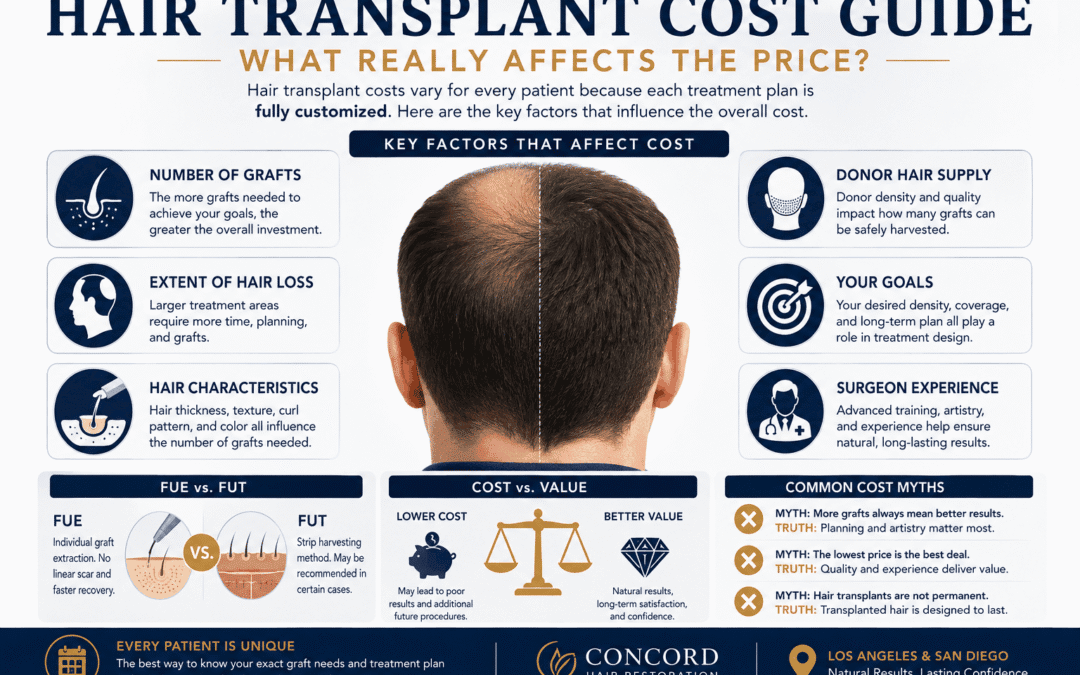
While it’s understandable to focus on price, the truth is that there isn’t a single cost that applies to every patient. Hair transplant procedures are highly personalized. Factors such as the extent of your hair loss, the number of grafts needed, your donor hair supply, and your long-term goals all influence the overall treatment plan.
Rather than asking, “What’s the cheapest hair transplant?” a better question is:
“What treatment will provide natural, lasting results for my unique situation?”
In this guide, we’ll explain the factors that influence the cost of hair restoration so you can make an informed decision.
Why Hair Transplant Costs Vary
Unlike many cosmetic procedures, hair transplantation isn’t one-size-fits-all.
Every patient has a unique combination of:
- Hair loss pattern
- Hair density
- Hair characteristics
- Donor supply
- Hairline goals
- Long-term hair loss progression
A personalized consultation allows your physician to evaluate these factors and recommend a treatment plan tailored to your needs.
Internal Link
If you’re still determining the stage of your hair loss, our Complete Norwood Scale Guide can help you better understand how male pattern baldness progresses.
The Biggest Factor: How Many Grafts You Need
The single biggest factor affecting cost is often the number of grafts required.
Every follicular unit (graft) contains one to several hairs.
Someone experiencing early temple recession may need significantly fewer grafts than someone restoring both the hairline and crown.
The goal isn’t to transplant the highest number of grafts possible.
The goal is to create natural density while preserving your donor supply for the future.
Internal Link
Learn more about donor planning in our upcoming Donor Area Guide.
What Determines Your Graft Count?
Your physician evaluates several factors, including:
- Your Norwood stage
- Hairline recession
- Crown thinning
- Existing hair density
- Hair caliber
- Hair color
- Curl pattern
- Donor density
- Future hair loss
Every treatment plan is customized.
Does More Grafts Mean Better Results?
Not necessarily.
This is one of the biggest misconceptions in hair restoration.
A natural-looking hair transplant depends on:
- Strategic graft placement
- Proper density
- Hairline artistry
- Appropriate graft distribution
- Long-term planning
A well-designed procedure using fewer grafts may produce a more natural appearance than an unnecessarily large procedure.
Why Experience Matters More Than Price
Hair transplantation combines medicine with artistry.
Natural-looking results require careful planning of:
- Hairline shape
- Direction of hair growth
- Angle of each graft
- Density transitions
- Facial proportions
These details often determine whether a result looks natural.
Choosing a clinic based solely on the lowest price may not provide the long-term outcome you’re hoping for.
FUE vs. FUT: Does the Technique Affect Cost?
The technique used may influence treatment planning and pricing.
FUE (Follicular Unit Extraction)
FUE involves removing individual follicular units from the donor area.
Benefits include:
- No linear scar
- Faster recovery for many patients
- Ability to wear shorter hairstyles
- Minimally invasive approach
At Concord Hair Restoration, FUE is the primary technique used because it allows for precise graft placement while avoiding a linear donor scar.
Learn more on our FUE Hair Transplant page.
FUT (Strip Method)
FUT involves removing a strip of scalp from the donor area before individual grafts are prepared.
While FUT may still be appropriate in select situations, many patients today prefer FUE because of its recovery profile and donor-area appearance.
Why the Cheapest Hair Transplant Isn’t Always the Best Value
Hair transplantation is often a once-in-a-lifetime procedure.
Choosing a clinic based solely on price may lead to:
- Unnatural hairlines
- Low graft survival
- Overharvesting
- Visible scarring
- Additional corrective procedures
The true value of a hair transplant comes from achieving natural, lasting results.
Hair Restoration Is a Long-Term Investment
Unlike temporary solutions that require ongoing purchases or maintenance, transplanted hair is designed to grow naturally over time.
Many patients view hair restoration as an investment in:
- Confidence
- Appearance
- Professional image
- Convenience
- Long-term self-esteem
When planned appropriately, a hair transplant can provide benefits that last for many years.
Does Financing Make Hair Restoration More Accessible?
Many practices offer financing options that allow qualified patients to spread treatment costs over time.
Rather than delaying treatment, financing may help patients begin their hair restoration journey sooner while making monthly payments that fit their budget.
Learn more on our Financing Options page.
Common Hair Transplant Cost Myths
Myth #1: Every Hair Transplant Costs the Same
Every patient requires a personalized treatment plan.
Myth #2: More Grafts Always Produce Better Results
Quality planning is more important than quantity.
Myth #3: The Lowest Price Is the Best Deal
A lower upfront cost doesn’t necessarily provide the best long-term value.
Myth #4: Hair Transplants Require Constant Maintenance
Transplanted follicles are typically taken from areas that are more resistant to the hormone responsible for male pattern baldness, making them a long-lasting solution for many patients.
How to Compare Hair Transplant Clinics
When comparing practices, consider:
✔ Experience
✔ Before-and-after photos
✔ Natural hairline design
✔ Personalized consultations
✔ Long-term planning
✔ Transparent recommendations
✔ Comprehensive follow-up care
The goal isn’t simply to find the lowest price.
The goal is to find a clinic that prioritizes natural, individualized results.
Frequently Asked Questions About Hair Transplant Cost
How much does a hair transplant cost?
The cost of a hair transplant varies because every treatment plan is customized. Factors such as the number of grafts needed, the extent of hair loss, your donor hair supply, and your long-term goals all influence the overall cost. A consultation is the best way to receive an individualized treatment recommendation.
What affects the cost of a hair transplant?
Several factors may affect the cost, including:
- Number of grafts needed
- Hair loss pattern
- Donor hair quality
- Hair characteristics
- Procedure complexity
- Treatment goals
- Surgical planning
- Whether additional treatments are recommended
Because every patient is unique, treatment plans are personalized rather than one-size-fits-all.
Does needing more grafts always mean better results?
No. Natural-looking results depend on careful planning, artistic hairline design, and strategic graft placement—not simply transplanting the highest number of grafts possible. An experienced physician focuses on achieving balanced, natural density while preserving donor hair for the future.
Is FUE more expensive than FUT?
Pricing depends on several factors, including the complexity of the procedure and your individualized treatment plan. At Concord Hair Restoration, FUE is the primary technique offered because it allows for precise graft placement and avoids a linear donor scar.
Is a hair transplant a permanent solution?
Transplanted follicles are typically taken from areas that are more resistant to the hormone associated with male pattern baldness. Once established, these follicles often continue growing for many years. However, untreated native hair may continue to thin over time, which is why long-term planning is important.
Can I finance a hair transplant?
Many patients choose financing options that allow qualified applicants to spread treatment costs into manageable monthly payments. During your consultation, our team can discuss available financing options and answer any questions.
Does insurance cover hair transplant surgery?
Hair transplantation is generally considered an elective cosmetic procedure and is typically not covered by health insurance. Coverage varies by insurance provider and individual circumstances.
Is traveling for a cheaper hair transplant worth it?
While price is one consideration, choosing a qualified physician and an experienced team is often more important than selecting the lowest-cost option. Factors such as natural hairline design, graft survival, follow-up care, and long-term planning all contribute to the overall value of treatment.
How do I know how many grafts I need?
Only a comprehensive consultation can accurately determine graft requirements. Your physician will evaluate your hair loss pattern, donor density, facial proportions, hair characteristics, and long-term goals before recommending a treatment plan.
What questions should I ask during a hair transplant consultation?
Helpful questions include:
- Am I a good candidate?
- How many grafts do you recommend?
- Why do you recommend that number?
- What results can I realistically expect?
- What will recovery look like?
- What financing options are available?
- How will you design my hairline?
- What happens if my hair loss progresses?
Final Thoughts
Every hair transplant is unique, which means the cost is based on much more than a single number. Your hair loss pattern, donor supply, treatment goals, and surgical plan all play a role in determining the right approach.
Instead of focusing only on price, consider the long-term value of natural-looking results, careful planning, and preserving your donor hair for the future. Choosing an experienced team and a personalized treatment plan can make a meaningful difference in your outcome.
If you’re considering a hair transplant in Los Angeles, scheduling a consultation is the best way to receive an individualized assessment and discuss the treatment options that are right for you.