One of the biggest concerns patients have before a hair transplant is simple:
Will people be able to tell I had one?
A well-planned modern hair transplant can look remarkably natural. Ideally, the transplanted hair should blend with your existing hair so well that someone looking at you simply sees your hair—not evidence of a procedure.
But natural-looking results are not automatic.
The final appearance depends on many factors, including hairline design, graft placement, hair direction, density, donor-hair characteristics and how the treatment plan accounts for future hair loss.
Research on hair transplantation consistently identifies hairline design, graft angle and direction, density, donor selection and follicular-unit placement as major factors affecting how natural a transplant looks. PubMed Central (PMC)
At Concord Hair Restoration, the goal is not simply to transplant as many hairs as possible. The goal is to create a result that works with the patient’s existing hair, facial proportions, donor supply and long-term pattern of hair loss.
Can a Hair Transplant Really Look Natural?
Yes.
Modern hair transplantation uses naturally occurring follicular units rather than the large plugs associated with older generations of hair restoration.
A follicular unit may contain one, two, three or sometimes more hairs. Using these naturally occurring groups gives the hair restoration team much greater control over where different types of grafts are placed.
Smaller follicular-unit grafts were a major advancement in creating more natural-looking transplantation results. PubMed Central (PMC)
But the size of the graft is only part of the equation.
A natural result requires all of the pieces to work together:
- Hairline shape
- Hairline height
- Graft size
- Hair direction
- Hair angle
- Density
- Distribution
- Donor management
- Existing hair
- Hair texture and caliber
- Future hair loss
A transplant can technically “grow” and still look unnatural if these details are not planned appropriately.
What Makes a Hair Transplant Look Natural?
Several elements have an especially large influence.
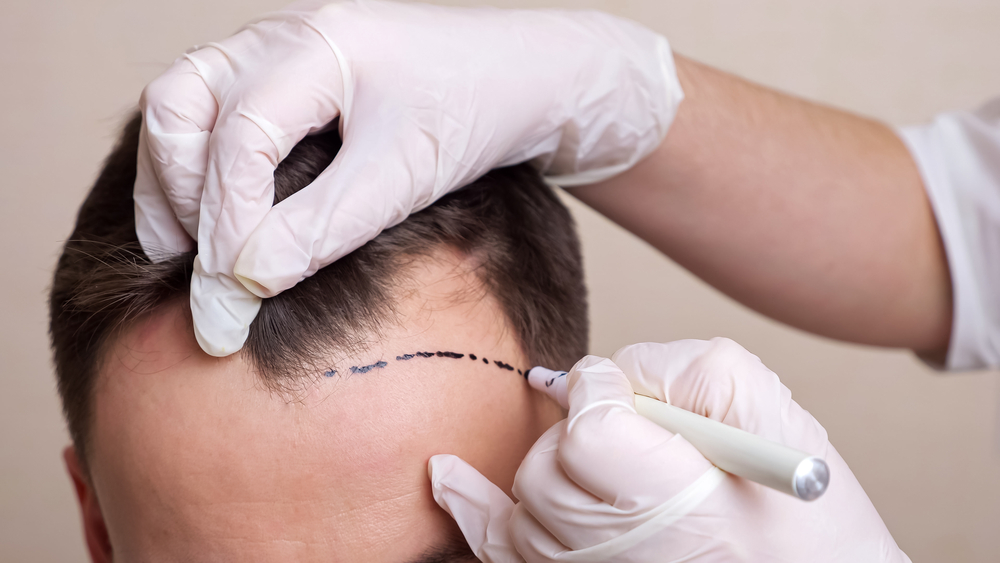
1. A Natural Hairline
The frontal hairline is one of the first things people notice.
Natural hairlines are not perfectly straight geometric lines.
There are small variations in position, density and individual hairs along the front edge. Research discussing correction of unnatural hair transplants emphasizes the importance of an irregular, feathered transition at the frontal hairline rather than a rigid line of evenly spaced grafts. PubMed Central (PMC)
A natural-looking design should also make sense for the patient’s:
- Age
- Facial proportions
- Existing hair
- Pattern of recession
- Available donor supply
- Expected future hair loss
Creating an excessively low or youthful hairline may look appealing initially but can become unnatural as surrounding native hair continues to thin.
For a deeper explanation, read [What Makes a Hairline Look Natural?](/what-makes-a-hairline-look-natural/).
2. Single-Hair Grafts at the Front
One of the details that separates a soft hairline from a “pluggy” one is the type of graft used at the leading edge.
Natural frontal hairlines generally contain finer individual hairs before gradually becoming denser farther back.
Placing large multi-hair grafts directly along the front can create a harsh appearance.
Hair-transplant literature emphasizes the importance of smaller follicular units and fine single hairs in the frontal transition zone. PubMed Central (PMC)
This creates a gradual transition from bare skin into fuller hair rather than an abrupt wall of density.
3. The Correct Hair Direction
Hair doesn’t simply grow straight upward across the entire scalp.
Its direction changes depending on location.
The frontal hairline, temples, sides, mid-scalp and crown all have characteristic growth patterns.
If transplanted grafts are placed in the wrong direction, they can look unnatural even if every graft survives.
Research on hair transplantation identifies the direction and angle of implanted hairs as major components of the aesthetic result. PubMed Central (PMC)
This is particularly important around the temples and crown, where the natural growth pattern can be more complex.
4. The Correct Angle
Direction tells us where the hair points.
Angle describes how closely the hair exits the scalp.
Natural hairs often emerge at relatively shallow angles in areas such as the hairline and temples.
If grafts are implanted too upright, transplanted hair can stand out from the surrounding hair rather than blending with it.
Improper graft angulation is a recognized cause of unnatural hair-transplant results. PubMed Central (PMC)
The goal is for transplanted hair to behave visually like the hair that naturally belongs in that area.
5. Appropriate Density
Patients understandably want their hair to look full.
But natural-looking hair restoration is not simply a matter of placing the largest possible number of grafts into every square inch.
The available donor supply is limited.
The treatment plan needs to distribute that supply strategically.
Factors that influence the appearance of density include:
- Number of grafts
- Hair shaft diameter
- Hair color
- Skin-to-hair contrast
- Curl
- Existing native hair
- Size of the treatment area
- Placement pattern
Hair-transplant research identifies density as one of the major factors affecting the aesthetic outcome. PubMed Central (PMC)
Sometimes the goal is to create the visual impression of greater fullness rather than recreate the exact density someone had before hair loss.
Learn more in our [Hair Transplant Density Explained](/hair-transplant-density-explained/) guide.
6. Blending With Existing Hair
A good transplant should not look like transplanted hair sitting separately from the patient’s natural hair.
It should blend.
That requires considering:
- Existing density
- Existing hair direction
- Existing hairline
- Miniaturized hair
- Areas likely to thin in the future
- Donor-hair characteristics
This becomes especially important for someone who still has considerable native hair in the recipient area.
The restoration plan needs to account for what happens if some of that original hair becomes thinner years later.
7. Planning for Future Hair Loss
Hair loss is often progressive.
This is one of the most important concepts in creating a transplant that continues looking natural over time.
A hairline that looks good immediately after surgery can become awkward if the natural hair behind it continues receding and the treatment plan did not anticipate that possibility.
Published discussion of unfavorable hair-transplant results identifies failure to account for progressive hair loss as an important reason some older transplants eventually look unnatural. PubMed Central (PMC)
The question therefore should not only be:
“How will this transplant look next year?”
It should also be:
“Can this design continue to make sense if my hair loss progresses?”
Does FUE Look More Natural Than FUT?
Not automatically.
This is something I would correct from the old version of this article.
FUE and FUT describe how donor follicles are harvested.
FUE removes follicular units individually.
FUT removes a strip of donor scalp that is then dissected into follicular units.
FUE has the advantage of avoiding the long linear donor scar associated with FUT, but the donor-harvesting method by itself does not determine whether the transplanted hairline looks natural.
Naturalness in the recipient area depends more heavily on factors such as:
- Hairline design
- Graft selection
- Placement
- Angle
- Direction
- Density
- Long-term planning
Both procedures can use follicular-unit grafts.
So it would be misleading to tell patients that choosing FUE automatically guarantees a more natural-looking hairline.
If you’d like to understand the differences in greater detail, see [FUE vs. FUT](/fue-vs-fut/).
Does NeoGraft Make Hair Transplants Look More Natural?
NeoGraft is an automated FUE system that assists with follicular extraction.
It can be part of a modern FUE procedure, but no machine independently creates a natural-looking result.
Technology can assist with harvesting follicles.
It cannot replace decisions involving:
- Hairline design
- Which grafts go where
- Recipient-site angle
- Hair direction
- Graft distribution
- Donor management
- Long-term planning
Those aspects of the procedure still matter enormously.
Learn more about [NeoGraft Hair Transplantation](/services/neograft-hair-transplant/).
Why Do Some Hair Transplants Look Fake?
Several problems can make transplanted hair more noticeable than it should be.
Common reasons include:
- A hairline that is too straight
- A hairline placed too low
- Large grafts at the front
- Incorrect hair direction
- Grafts implanted at unnatural angles
- Poor density distribution
- Excessive symmetry
- Failure to account for future hair loss
- Poor blending with native hair
- Inappropriate donor-hair use
These types of design and technical problems have been documented in the medical literature discussing unfavorable hair-transplant outcomes. PubMed Central (PMC)
We cover this topic separately in [Why Some Hair Transplants Look Unnatural](/why-some-hair-transplants-look-unnatural/).
Should a Hairline Be Perfectly Symmetrical?
Not necessarily.
Real human hairlines aren’t manufactured with a ruler.
Small irregularities can actually contribute to a more natural appearance.
Research on hairline design has emphasized both irregularity and asymmetry as characteristics that can help prevent an artificial appearance. PubMed Central (PMC)
This does not mean the hairline should look sloppy or random.
It means that natural design often involves subtle variations rather than creating an unnaturally perfect geometric border.
What About the Crown?
The crown presents a different challenge from the frontal hairline.
Crown hairs typically follow a whorl or spiral-like pattern.
Simply placing grafts in straight rows would not reproduce that natural growth pattern.
Recipient-site planning should follow the natural direction of hair within the crown and account for the whorl pattern. PubMed Central (PMC)
The crown can also consume a substantial number of grafts because it covers a relatively large surface area.
That makes donor allocation especially important when someone needs restoration in both the frontal scalp and crown.
Does Hair Texture Affect How Natural a Transplant Looks?
Yes.
Hair characteristics affect the amount of visual coverage a given number of grafts can produce.
Factors can include:
- Hair thickness
- Curl
- Wave
- Hair color
- Scalp color
- Contrast between hair and skin
For example, thicker or curlier hair can often provide more visual coverage than very fine, straight hair. PubMed Central (PMC)
This is another reason two people receiving the same number of grafts may have very different-looking results.
Graft count alone does not determine the final appearance.
Can a Hair Transplant Look Too Dense?
Potentially.
Density needs to be balanced against donor supply, scalp characteristics and long-term goals.
Attempting to recreate youthful density everywhere can consume an enormous number of grafts and may not be realistic for someone with extensive hair loss.
A strategically designed transplant can create the appearance of fullness without attempting to reproduce every follicle that existed before hair loss.
That is why the question:
“How many grafts can you put in?”
is less useful than:
“How should my available grafts be distributed for the most natural long-term result?”
See [How Many Hair Grafts Do I Need?](/how-many-grafts-do-i-need/).
When Does a Hair Transplant Start Looking Natural?
Hair transplantation is a gradual process.
The appearance immediately after surgery is not the final result.
The transplanted follicles need to heal, and the initially transplanted hairs commonly go through shedding and regrowth phases.
New growth develops over the following months and continues to mature.
That means judging how natural a transplant looks too early can be misleading.
For a detailed breakdown of the process, read our [Hair Transplant Timeline](/hair-loss/different-types-of-hair-loss/hair-transplant-timeline/).
How Can You Judge Whether a Clinic Produces Natural Results?
One of the most useful things a prospective patient can do is examine actual patient results.
Don’t look only at one dramatic before-and-after image.
Look for consistency.
Pay attention to:
- Hairline softness
- Natural temple transitions
- Graft direction
- Density
- Crown patterns
- Donor-area appearance
- Results from patients with hair similar to yours
- Different degrees of hair loss
You can view Concord Hair Restoration’s [Before & After Gallery](/gallery/) and [Hair Restoration Case Studies](/hair-restoration-case-studies/) to see examples of patient outcomes.
Individual results vary, but real patient examples can help you understand a clinic’s general aesthetic approach.
Can People Tell You’ve Had a Hair Transplant?
With a natural-looking result, the goal is that the transplant does not immediately draw attention to itself.
People may notice that someone’s hair looks fuller or that their appearance has changed, but the hairline itself should not obviously announce, “This is transplanted hair.”
Of course, no clinic can guarantee that a procedure will be undetectable in every circumstance.
Results depend on individual anatomy, donor supply, hair characteristics, healing and the extent of hair loss.
The better question is whether the treatment plan is designed around the individual rather than trying to apply the same hairline and graft distribution to every patient.
Can an Unnatural Hair Transplant Be Fixed?
Sometimes.
Depending on the problem and remaining donor supply, corrective transplantation may be able to improve issues such as:
- Pluggy hairlines
- Poor graft direction
- Low hairlines
- Sparse areas
- Uneven density
- Visible scars
- Poor integration with existing hair
But repair procedures can be more complicated because some donor hair has already been used.
That makes getting the planning right the first time especially valuable.
If you’re dealing with previous work you are unhappy with, see our guide to [Hair Transplant Repair](/hair-transplant-repair/).
Frequently Asked Questions About Natural-Looking Hair Transplants
Do modern hair transplants look natural?
They can. Modern follicular-unit transplantation allows hairs to be placed individually or in naturally occurring small groups. The final appearance depends heavily on design, direction, angle, density and graft distribution. PubMed Central (PMC)
Can FUE look fake?
Yes. FUE describes the donor-harvesting method. Poor hairline design or incorrect graft placement can still create an unnatural result even when FUE is used.
Is FUE more natural-looking than FUT?
Not necessarily. Both techniques can transplant follicular-unit grafts. FUE avoids a linear donor scar, but natural appearance in the recipient area depends largely on how the grafts are designed and placed.
What makes a transplanted hairline look natural?
Important elements include a soft transition zone, appropriate hairline shape, single-hair grafts along the front, correct direction and angle, appropriate density and long-term planning. PubMed Central (PMC)
Can transplanted hair blend with existing hair?
Yes, when the procedure is planned appropriately. Hair caliber, direction, density and the likely progression of surrounding natural hair should all be considered.
Can a hair transplant look natural as you get older?
That is one of the goals of conservative long-term planning. A hairline should make sense not only at the time of surgery but also as the patient’s appearance and hair loss change over time. PubMed Central (PMC)
How can I see whether Concord’s results look natural?
Review the [Before & After Gallery](/gallery/) and [Hair Restoration Case Studies](/hair-restoration-case-studies/). Look at hairline design, density, donor appearance and how the transplanted hair blends with the patient’s existing hair.
Natural-Looking Hair Restoration Starts With the Plan
Modern hair transplantation gives patients the possibility of results that look significantly more natural than the obvious plug-style procedures associated with earlier eras.
But technology alone does not create a natural result.
Hairline design, graft selection, placement angle, direction, density, donor management and planning for future hair loss all work together.
At Concord Hair Restoration, hair restoration plans are individualized according to the patient’s existing hair, donor supply, hair-loss pattern and goals.
Explore:
Hair Transplant Los Angeles
FUE Hair Transplant Los Angeles
Hair Transplant San Diego
Before & After Gallery
Los Angeles: (818) 800-2002
San Diego: (619) 905-4247
Schedule a consultation to discuss what a natural-looking hair restoration plan could look like for your individual hair-loss pattern.