
Quick Summary
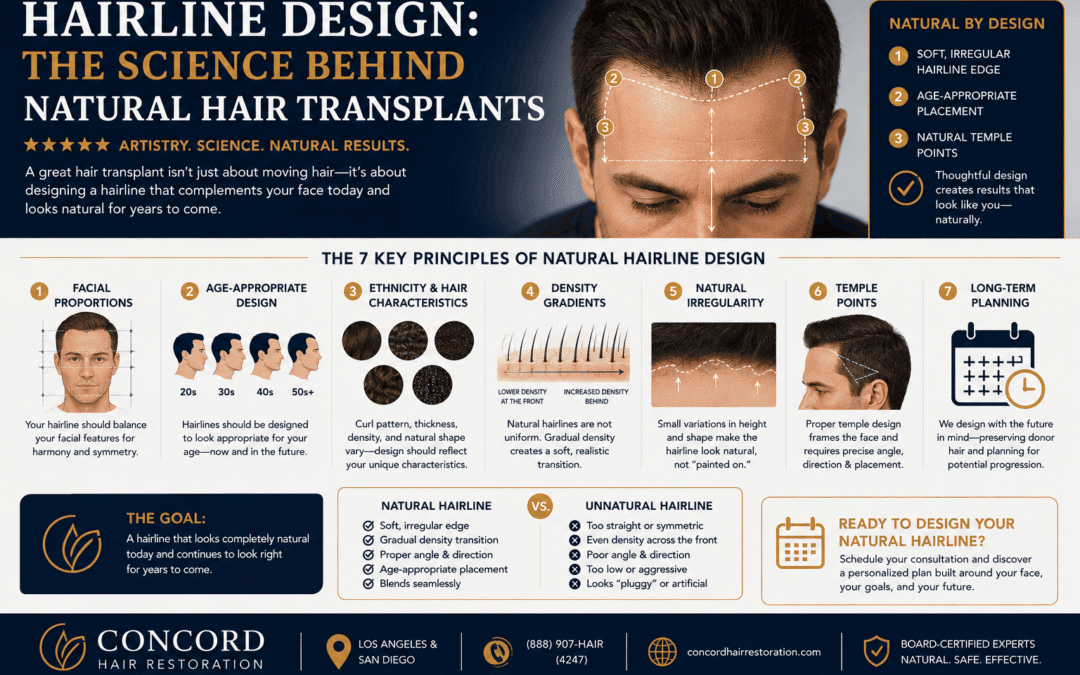
A successful hair transplant isn’t simply about moving hair from one part of the scalp to another. The most natural-looking results come from thoughtful hairline design that considers facial proportions, age, ethnicity, hair characteristics, donor availability, and how your hair loss may progress over time.
At Concord Hair Restoration, we believe hairline design is where medicine meets artistry. A carefully planned hairline can restore confidence while looking like the hairline you naturally would have had—not one that appears surgically created.
Why Hairline Design Matters More Than Most People Realize
Many people focus on how many grafts they’ll receive.
Experienced hair restoration surgeons often focus on a different question first:
Where should those grafts actually go?
Thousands of grafts placed in the wrong location can still produce an unnatural appearance.
Meanwhile, fewer grafts strategically placed often create an excellent cosmetic improvement.
The hairline is the first thing people notice when they look at your face.
Because of that, its design deserves careful planning—not guesswork.
Hairline Design Is Both Science and Art
Natural hairlines follow patterns that are surprisingly consistent.
A surgeon considers numerous variables before making the first tiny incision.
These include:
- Facial proportions
- Forehead height
- Hair characteristics
- Age
- Ethnicity
- Existing hair
- Future hair loss
- Donor supply
- Desired hairstyle
Every patient is unique.
No template works for everyone.
Understanding Facial Proportions
One of the biggest goals is creating facial balance.
Rather than simply lowering a hairline, surgeons evaluate how it complements the rest of your face.
Important considerations include:
- Forehead height
- Face length
- Brow position
- Eye spacing
- Nose size
- Jawline
- Overall facial symmetry
The objective isn’t to create the lowest possible hairline.
It’s creating the right hairline.
A well-positioned hairline often makes the entire face appear younger without anyone realizing why.
Why Lower Isn’t Always Better
One of the biggest misconceptions about hair restoration is:
“I want my hairline back exactly where it was when I was 18.”
For most adults, that usually isn’t the best choice.
An extremely low juvenile hairline can look unnatural on a mature face.
Instead, experienced surgeons typically create a hairline that appears age-appropriate while preserving grafts for the future.
Age-Appropriate Hairline Design
Hair naturally changes throughout life.
Even men who never experience significant baldness often develop a mature hairline.
Creating an age-appropriate design helps the transplant blend naturally for decades.
Patients in their 20s
Conservative planning is especially important because future hair loss may still occur.
The focus is usually on preserving donor hair while avoiding aggressive lowering.
Patients in their 30s and 40s
Hairline restoration often becomes more predictable because the pattern of hair loss is easier to evaluate.
Patients over 50
Goals often shift toward natural density and facial framing rather than recreating a youthful teenage hairline.
The best transplant should still look appropriate 20 years from now.
The Importance of Ethnicity
Natural hairlines vary considerably among different ethnic backgrounds.
Experienced surgeons recognize these differences.
Factors may include:
- Hair caliber
- Curl pattern
- Hair direction
- Density
- Temple shape
- Forehead proportions
Designing a hairline that respects these natural characteristics often produces more believable results.
Hair Direction Matters
Natural hair doesn’t grow straight upward.
Every follicle exits the scalp at a specific angle.
Those angles vary across the hairline.
For example:
- Central hairs often angle slightly forward.
- Temple hairs grow flatter against the scalp.
- Side hair follows different directional patterns.
- Crown hairs rotate in a spiral.
Even if density is excellent, incorrect hair direction can make a transplant appear unnatural.
The Secret Most People Never Notice: Density Gradients
One common mistake is creating the same density everywhere.
Natural hairlines don’t work that way.
Instead, density changes gradually.
The very front edge typically contains fewer hairs.
Density slowly increases as you move backward.
This gradual transition creates softness.
Without it, a hairline may appear too sharp or “painted on.”
Natural Hairlines Are Slightly Irregular
Perfect symmetry rarely exists in nature.
Small irregularities actually make hairlines look more realistic.
These variations may include:
- Tiny changes in height
- Slight asymmetry
- Different follicle groupings
- Individual hairs extending beyond the main hairline
These subtle details help avoid an artificial appearance.
Temple Points Are Often Overlooked
Temple points are the triangular areas on the sides of the forehead.
They’re one of the most technically challenging aspects of hair restoration.
Why?
Because temple hairs:
- Grow almost flat against the skin
- Follow unique directional patterns
- Require extremely precise graft placement
- Usually use finer hairs
Even minor errors may be noticeable.
Proper temple restoration can dramatically improve facial framing.
Choosing the Right Hair for the Hairline
Not every follicular unit belongs at the front.
The most natural hairlines often use:
- Single-hair grafts along the leading edge
- Smaller follicular units in transition zones
- Larger follicular units farther behind the hairline
This creates a gradual, feathered appearance rather than an abrupt wall of hair.
Long-Term Planning Is Essential
One of the biggest differences between experienced hair restoration surgeons and less experienced providers is long-term planning.
Hair loss is often progressive.
If a hairline is designed without considering future changes, patients may eventually need significant revisions.
That’s why surgeons evaluate:
- Family history
- Current hair loss pattern
- Age
- Donor reserves
- Hair characteristics
- Likelihood of future recession
Preserving donor hair today may provide better options tomorrow.
Donor Supply Is Limited
Every patient has a finite donor area.
Those follicles are valuable.
Using too many grafts too early can reduce future options.
Thoughtful planning balances:
- Current cosmetic goals
- Future hair loss
- Donor preservation
- Natural appearance
This is one reason personalized treatment planning is so important.
Hairline Design for Women
Women’s hairlines often differ from men’s.
Generally speaking, female hairlines may appear:
- Lower
- Softer
- More rounded
- Less recessed at the temples
Design considerations also depend on:
- Hair styling
- Part location
- Existing density
- Hair texture
Patients interested in female hair restoration can learn more about our Eyebrow Hair Transplant and resources covering Women’s Hair Loss.
Technology Doesn’t Replace Experience
Advanced FUE technology is incredibly valuable.
However, technology alone doesn’t determine results.
Hairline design still depends on:
- Surgical planning
- Artistic judgment
- Experience
- Understanding facial aesthetics
- Knowledge of hair biology
Even the best equipment cannot compensate for poor design decisions.
Why Consultation Matters
Every patient’s goals are different.
During a consultation, your surgeon evaluates:
- Hair loss pattern
- Donor density
- Hair caliber
- Curl characteristics
- Facial proportions
- Future hair loss risk
- Cosmetic goals
This personalized evaluation helps determine whether you’re a good candidate for FUE Hair Transplant Surgery and what type of hairline design may be appropriate.
Patients considering treatment in Southern California can also learn more about our Hair Transplant Los Angeles location or our San Diego Hair Restoration office.
Common Hairline Design Mistakes
Natural-looking results often depend on avoiding several common errors, including:
- Hairlines placed too low
- Straight, perfectly symmetrical hairlines
- Uniform density across the entire front
- Poor graft angulation
- Overharvesting the donor area
- Ignoring future hair loss
- Restoring only the front while neglecting facial balance
- Using too many multi-hair grafts at the leading edge
Final Thoughts
Hair transplantation is about much more than replacing lost hair.
It’s about restoring balance, confidence, and natural appearance.
The most successful procedures rarely attract attention because the result simply looks like your own hair.
Thoughtful planning, artistic hairline design, and long-term strategy are what separate an average transplant from an exceptional one.
If you’re considering hair restoration, scheduling a consultation allows you to learn how a personalized treatment plan can help you achieve results that look natural today—and continue looking natural for years to come.
Frequently Asked Questions About Hairline Design
What makes a hair transplant hairline look natural?
A natural-looking hairline is created by carefully considering facial proportions, age, hair direction, density, irregularity, and long-term hair loss patterns. The goal is to design a hairline that complements your face rather than simply placing it as low as possible.
Can a hairline be designed too low?
Yes. An overly low hairline may look unnatural as you age and can require significantly more donor hair than necessary. Conservative, age-appropriate hairline design often produces more natural and sustainable results.
Why doesn’t a natural hairline look perfectly straight?
Natural hairlines have subtle irregularities. Tiny variations in height, spacing, and follicle placement help create a softer appearance that blends naturally with existing hair.
Does my age affect my hairline design?
Absolutely. Surgeons typically design hairlines differently for someone in their 20s than for someone in their 50s. Future hair loss is an important consideration, and preserving donor hair for the future is often part of the treatment plan.
Why are temple points important?
Temple points help frame the face and contribute significantly to a natural appearance. Because the hairs grow at very shallow angles, restoring temple points requires careful planning and precise graft placement.
Does ethnicity affect hairline design?
Yes. Hair characteristics such as curl, density, caliber, growth direction, and natural hairline shape often vary among individuals. Hairline design should complement each patient’s unique facial features and hair characteristics.
What are density gradients?
A natural hairline is not equally dense from front to back. The leading edge typically contains fewer hairs, while density gradually increases behind it. This gradual transition creates a softer, more realistic appearance.
Why are single-hair grafts often used at the front?
The front edge of a natural hairline is typically made up of individual hairs. Using single-hair follicular units along the leading edge helps create a feathered, natural-looking transition.
Can a poorly designed hairline be corrected?
In many cases, revision hair transplant surgery may improve an unnatural hairline. However, revision procedures can be more complex because donor hair has already been used, making careful planning especially important.
Why is long-term planning so important?
Hair loss often continues over time. Designing a hairline without considering future hair loss may create an unnatural appearance later. Experienced surgeons aim to preserve donor hair while creating results that continue looking natural for years.
Is donor hair limited?
Yes. Every patient has a finite supply of donor hair, usually from the back and sides of the scalp. Strategic use of this donor supply is one of the most important aspects of successful hair restoration.
Is hairline design more important than the number of grafts?
Many surgeons would say yes. While graft count matters, natural results often depend more on proper hairline placement, direction, density, and artistic planning than simply transplanting a large number of follicles.