
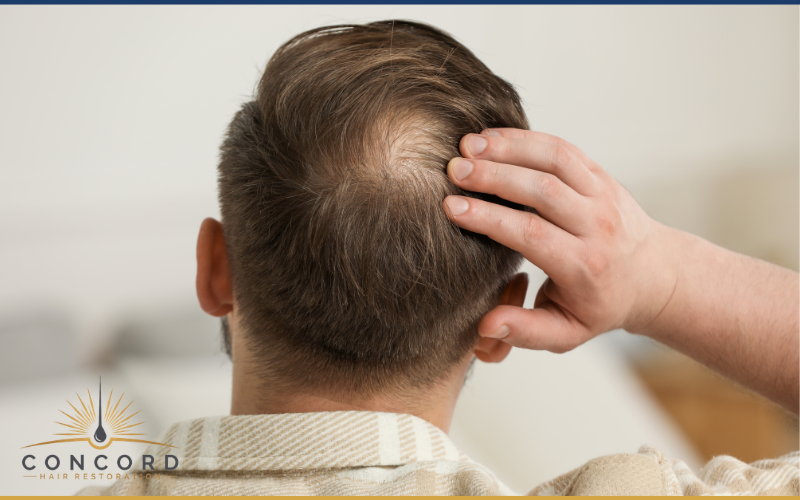
Not all hair loss looks the same. Some people notice clear bald patches or a receding hairline. Others look in the mirror and think, “I still have hair everywhere… it just feels thinner.”
This second pattern—known as diffuse thinning—is one of the most common and misunderstood forms of hair loss. It also requires a very different restoration strategy than isolated bald spots.
Understanding whether you’re dealing with diffuse thinning or focal hair loss can make the difference between a smart, effective plan and one that misses the mark.
What Is Diffuse Thinning?
Diffuse thinning occurs when hair density gradually decreases across a larger area of the scalp, rather than forming a distinct bald spot.
People with diffuse thinning often experience:
- Overall loss of volume
- Increased scalp visibility under light
- Ponytails or parts that look thinner
- Hair that feels finer over time
Importantly, hair is still present, but many follicles are producing thinner, weaker strands (a process called miniaturization).
What Are Bald Spots or Patterned Hair Loss?
Bald spots or patterned hair loss occur when follicles in specific areas stop producing visible hair altogether.
Common examples include:
- Receding hairline at the temples
- Crown (vertex) bald spot
- Clear patches with little to no hair growth
These areas are usually easier to identify—and often easier to plan for surgically—because the boundaries are well defined.
Why Diffuse Thinning Requires Different Planning
This is where many people get frustrated.
With diffuse thinning:
- There is no clear “target area”
- The risk of over-harvesting donor hair is higher
- Transplanted hair must blend with existing thinning hair
- The goal is often density enhancement, not full coverage
Hair restoration planning must be conservative, strategic, and highly individualized.
Can Diffuse Thinning Be Treated With a Hair Transplant?
Sometimes—but not always.
A hair transplant may be appropriate if:
- There is enough contrast between donor and thinning areas
- The thinning pattern is stable
- Density goals are realistic
- Donor hair quality is strong
In other cases, non-surgical or combined approaches may be more appropriate, especially when thinning is widespread and progressive.
This is why diffuse thinning is less about “yes or no” and more about how and when.
Diffuse Thinning vs Bald Spots: Key Differences
Diffuse Thinning
- Hair present everywhere, but density is reduced
- Follicles are weakened, not absent
- Requires careful donor management
- Often benefits from a blended or phased approach
Bald Spots
- Clear areas with little or no hair growth
- Easier to define surgical targets
- Transplants often focus on restoration rather than blending
- Results can be more immediately visible
Who Is a Candidate for Hair Restoration With Diffuse Thinning?
Candidacy depends on more than appearance alone. Key factors include:
- Degree of miniaturization
- Donor hair density and caliber
- Family history and progression speed
- Age and long-term expectations
This is why visual inspection alone isn’t enough. At our Los Angeles clinic, we evaluate candidacy using pattern staging and donor analysis to determine whether surgical or non-surgical hair restoration makes sense.
Why Early Evaluation Matters for Diffuse Thinning
Diffuse thinning often progresses quietly. By the time it becomes obvious, options may be more limited.
Early evaluation allows for:
- Preservation of donor hair
- Stabilization strategies
- Better long-term outcomes
- Avoidance of unnecessary or premature surgery
In hair restoration, timing and planning matter as much as technique.
What Results Are Realistic?
For diffuse thinning patients, realistic goals often include:
- Improved density and coverage
- Reduced scalp visibility
- Better hair texture and strength
- Natural blending with existing hair
The objective is not perfection—it’s balance, longevity, and natural appearance.
FAQs: Diffuse Thinning Hair Restoration
What causes diffuse thinning?
Diffuse thinning can be caused by genetics, hormonal changes, stress, nutritional factors, or medical conditions that affect hair growth cycles.
Is diffuse thinning the same as female pattern hair loss?
Not exactly. Diffuse thinning describes the pattern, while female pattern hair loss refers to a specific underlying cause and distribution.
Can a hair transplant fix diffuse thinning?
In some cases, yes—but planning must be conservative and donor hair must be sufficient. Not all diffuse thinning patients are surgical candidates.
How is diffuse thinning diagnosed?
Diagnosis involves scalp evaluation, assessment of miniaturization, donor analysis, and a review of hair loss history.
Is diffuse thinning permanent?
It can be progressive, but early intervention and proper planning can slow or manage the condition effectively.
Should I wait until bald spots appear?
Waiting can limit options. Early assessment often provides more flexibility and better outcomes.