Thinning hair can gradually change the way you look and feel. You may notice that your hairline appears less defined, your scalp is becoming more visible, or your usual hairstyle no longer provides the coverage it once did.
Hair loss can affect both men and women, and it may develop for many different reasons. Genetics, hormonal changes, aging, certain medical conditions, stress, medications, and nutritional factors can all contribute to thinning hair.
For patients with an appropriate pattern of permanent hair loss and a healthy donor area, a NeoGraft hair transplant may offer a lasting way to restore coverage using their own natural hair.
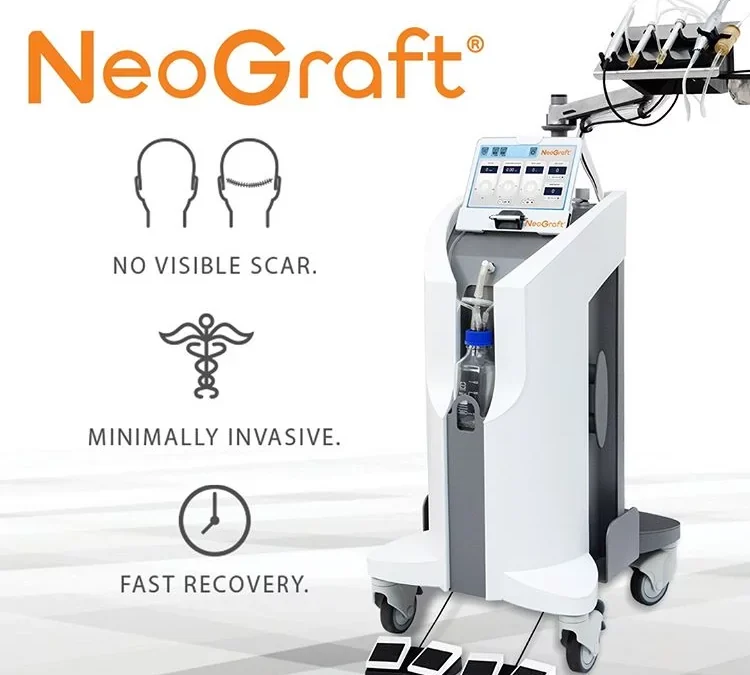
NeoGraft is an advanced system used to assist with Follicular Unit Extraction, commonly called FUE. Rather than removing a strip of scalp, the procedure involves extracting individual follicular units from the donor area and transplanting them into areas affected by thinning or baldness.
When treatment is carefully planned and performed by an experienced physician, NeoGraft-assisted FUE can create natural-looking improvement without leaving the long linear donor scar associated with traditional strip harvesting.
Quick Summary
A NeoGraft hair transplant is an FUE hair restoration procedure that uses automated technology to assist with the extraction of individual follicular units.
Potential advantages include:
- No long linear donor scar
- Individual follicular-unit extraction
- Local anesthesia
- A relatively discreet recovery
- Natural-looking hairline and density planning
- The ability to use your own permanent donor hair
- Long-lasting growth from successfully transplanted follicles
However, NeoGraft is a surgical tool rather than a substitute for physician judgment. The final result still depends on proper candidacy evaluation, donor management, hairline design, graft handling, placement angle, density planning, aftercare, and realistic expectations.
What Is a NeoGraft Hair Transplant?
NeoGraft is a medical device used to assist with the Follicular Unit Extraction method of hair transplantation.
During FUE, naturally occurring follicular units are individually removed from a donor area, usually along the back or sides of the scalp. These areas are commonly selected because their follicles tend to be more resistant to the hormonal effects associated with pattern hair loss.
The harvested follicular units are then prepared and carefully placed into recipient sites created in areas where greater coverage is desired.
A follicular unit may contain:
- One hair
- Two hairs
- Three hairs
- Occasionally four or more hairs
Single-hair follicular units are often valuable along the front of the hairline because they can create a softer transition. Multi-hair grafts may be placed farther behind the hairline to help build the appearance of density.
The NeoGraft system assists with parts of the extraction and implantation process, but the quality of the result still depends heavily on the treatment plan and the people performing the procedure.
Learn more about the treatment:
NeoGraft Hair Transplant
How Does NeoGraft FUE Work?
A NeoGraft procedure generally includes several important stages.
Consultation and Candidacy Evaluation
Before recommending surgery, the physician should evaluate:
- The cause of your hair loss
- Your current pattern of thinning
- The stability of your hair loss
- Donor hair density
- Hair texture and caliber
- Scalp health
- Medical history
- Age
- Family history
- Long-term goals
Not every form of hair loss should be treated surgically. Temporary shedding, active scalp disorders, certain autoimmune conditions, and some forms of diffuse hair loss may require a different treatment approach.
The consultation is also an opportunity to discuss what can realistically be achieved with your available donor supply.
Hairline and Treatment-Area Planning
Before follicles are harvested, the physician designs the proposed hairline and determines how grafts should be distributed throughout the treatment area.
This stage requires careful consideration of:
- Facial proportions
- Forehead shape
- Existing hair
- Hair direction
- Age
- Temple recession
- Donor supply
- Future hair loss
A natural-looking result should be planned to complement the patient’s appearance today while remaining appropriate as the patient ages.
Preparing the Donor Area
The donor area is usually trimmed or shaved so individual follicular units can be identified and extracted safely.
Local anesthesia is administered to help keep the patient comfortable. The exact preparation process may vary according to the treatment plan and the number of grafts required.
Extracting Individual Follicular Units
The NeoGraft device assists with removing individual follicular units from the donor area.
Unlike FUT, NeoGraft FUE does not require removing a long strip of scalp. Instead, it creates many small, circular extraction sites distributed throughout the donor region.
These sites typically become less noticeable as the area heals, although FUE is not completely scar-free. Every surgical extraction creates some degree of tissue change, and overly aggressive harvesting can produce visible donor thinning.
Preparing and Protecting the Grafts
After extraction, follicular units must be handled carefully to help maintain their viability.
The grafts may be inspected, sorted, counted, and kept in an appropriate holding solution until they are ready for placement.
Careful graft handling matters because follicles can be vulnerable to:
- Dehydration
- Physical trauma
- Excessive time outside the body
- Improper storage conditions
- Poor handling during placement
Creating Recipient Sites
Small recipient sites are created in the areas where the follicles will be transplanted.
The position, angle, direction, and distribution of these sites influence how the new hair will grow and how natural the result will appear.
Hair along the frontal hairline should generally be placed differently from hair in the mid-scalp or crown. Matching the natural growth pattern is a critical part of treatment planning.
Placing the Follicular Units
The harvested grafts are then placed into the recipient sites according to the treatment plan.
Single-hair grafts may be used near the front to soften the hairline, while grafts containing multiple hairs may be used behind them to add visual density.
The procedure may take several hours depending on the number of grafts, the size of the treatment area, and the complexity of the plan.
Is NeoGraft the Same as FUE?
NeoGraft and FUE are related, but they are not two entirely separate hair transplant procedures.
FUE is the surgical harvesting method. NeoGraft is a device that assists with the FUE process.
This means that a NeoGraft hair transplant is a form of FUE hair transplantation.
The important distinction is that NeoGraft does not independently determine:
- Whether you are a suitable candidate
- Where your hairline should be placed
- How many grafts should be used
- Which follicles should be harvested
- How the donor area should be preserved
- At what angle the grafts should be placed
- How density should be distributed
Those decisions require medical evaluation, surgical planning, and artistic judgment.
Technology can support a procedure, but it does not replace the experience of the physician or the importance of a personalized treatment plan.
Learn more about FUE:
What Is Follicular Unit Extraction?
NeoGraft FUE vs. FUT Hair Transplantation
NeoGraft-assisted FUE and Follicular Unit Transplantation use different methods to obtain donor follicles.
NeoGraft-Assisted FUE
During NeoGraft-assisted FUE:
- Follicular units are extracted individually
- No long strip of scalp is removed
- Small circular extraction sites are distributed throughout the donor area
- Many patients can wear shorter hairstyles after healing
- Donor harvesting can be customized across the safe donor region
FUT
During FUT:
- A narrow strip of scalp is removed from the donor area
- The strip is divided into individual follicular units
- The incision is closed, leaving a linear scar
- The surrounding hair may conceal the scar
- It may be appropriate for certain patients and graft requirements
Neither method is universally better for every patient.
The right option depends on factors such as donor density, scalp characteristics, hairstyle preferences, prior procedures, graft requirements, future plans, and the patient’s individual goals.
Compare both techniques:
The Differences Between FUE and FUT Hair Transplants
Who May Be a Candidate for NeoGraft?
NeoGraft-assisted FUE may be considered for men or women who have an appropriate form of hair loss and enough healthy donor hair to support transplantation.
Potential candidates may include patients with:
- Male pattern baldness
- Female pattern hair loss
- A receding hairline
- Thinning at the temples
- Mid-scalp thinning
- Crown thinning
- Certain stable scars with hair loss
- Adequate donor density
- Realistic expectations
A suitable candidate should generally have a donor area that can provide enough follicles without creating excessive thinning.
Patients should also understand that a hair transplant redistributes existing hair. It does not create an unlimited new supply of follicles.
When NeoGraft May Not Be the Right Treatment
Not everyone experiencing thinning hair is automatically a candidate for surgical restoration.
NeoGraft may not be appropriate when:
- The cause of hair loss has not been identified
- Hair loss is temporary
- The donor area is too limited
- Hair loss is progressing rapidly
- The scalp has an untreated medical condition
- Expectations exceed what the donor supply can provide
- The patient is not medically cleared for surgery
- The treatment area is too large for meaningful coverage
- Hair loss is diffuse throughout the proposed donor region
Some patients may benefit from delaying surgery, considering nonsurgical treatment, or receiving further medical evaluation before making a decision.
Can Women Have a NeoGraft Hair Transplant?
Women may be candidates for NeoGraft-assisted FUE, but female hair loss requires careful evaluation.
Unlike many men who develop a predictable pattern of recession and crown loss, women may experience diffuse thinning across a broader portion of the scalp. In some cases, the proposed donor region may also be affected.
Possible causes of hair loss in women include:
- Female pattern hair loss
- Hormonal changes
- Menopause
- Thyroid conditions
- Iron deficiency
- Certain medications
- Stress-related shedding
- Traction alopecia
- Autoimmune conditions
- Postpartum changes
Because the cause and pattern of thinning matter, women should receive an individualized assessment before surgery is recommended.
A woman may be a stronger candidate when she has a stable area of permanent hair loss and a healthy donor region that is not undergoing significant miniaturization.
Can NeoGraft Create Natural-Looking Results?
NeoGraft-assisted FUE can produce natural-looking results, but the device alone does not guarantee them.
The appearance of a transplant depends on several factors:
- Hairline design
- Graft selection
- Placement angle
- Placement direction
- Density distribution
- Donor management
- Hair characteristics
- Existing hair
- Future hair loss
- Physician experience
A natural frontal hairline usually includes subtle variations rather than a perfectly straight row of uniformly spaced hairs.
Single-hair grafts are often positioned near the leading edge, while larger follicular units may be placed behind them. This helps create a gradual transition that more closely resembles natural growth.
The best result is not necessarily the lowest hairline or the highest graft count. It is a balanced design that complements the patient’s face and uses the available donor supply responsibly.
Learn more:
Do Hair Transplants Ever Look Natural?
Why Donor Management Matters
Donor hair is a limited resource.
Although individual follicles can be moved to another area of the scalp, the donor region does not regenerate an unlimited supply of replacement grafts.
Removing too many follicles or extracting them unevenly may cause:
- Visible donor thinning
- Patchiness
- Reduced coverage
- Limited options for future surgery
- An unnatural appearance with shorter hairstyles
A responsible treatment plan considers both the recipient area and the long-term appearance of the donor area.
The physician should determine how many follicles can be harvested safely while preserving enough surrounding density.
Learn more:
Donor Area Management: Avoiding Overharvesting
How Many NeoGraft Grafts Will You Need?
The number of grafts required varies considerably from one patient to another.
Factors that influence graft planning include:
- The size of the thinning area
- The location of the treatment area
- Existing hair density
- Donor availability
- Hair caliber
- Hair texture
- Hair color and skin contrast
- Hairline position
- Desired coverage
- Future hair loss
- Previous transplant procedures
A patient treating a small area of temple recession may need a very different number of grafts than someone restoring the frontal hairline, mid-scalp, and crown.
Graft count should not be determined solely from a photograph or based on a promotional package. An in-person or detailed virtual evaluation can provide a more meaningful estimate.
Learn more:
What Are the Potential Benefits of NeoGraft?
NeoGraft-assisted FUE may provide several potential benefits for appropriate candidates.
No Long Linear Donor Scar
Because individual follicular units are extracted rather than removing a strip of tissue, FUE does not create the long linear scar associated with FUT.
However, it is more accurate to describe FUE as avoiding a linear scar rather than being completely scar-free. Small extraction marks may remain, although they are often difficult to see after healing when harvesting is performed properly.
Greater Hairstyle Flexibility
The absence of a linear scar may allow many patients to wear their hair shorter after the donor area heals.
The degree of visibility still depends on extraction size, donor density, skin characteristics, healing, and how closely the hair is cut.
Local Anesthesia
NeoGraft procedures are generally performed using local anesthesia. Patients typically remain awake during treatment, although the clinic may provide additional comfort measures according to the individual treatment plan.
Personalized Graft Distribution
Individual extraction and placement allow the treatment team to select and distribute follicular units according to the needs of the hairline, mid-scalp, crown, or other treatment area.
Natural Hair Characteristics
Because the transplanted follicles come from your own scalp, the emerging hair retains its natural characteristics, including color, texture, and growth behavior.
A Relatively Discreet Recovery
Many patients can return to light daily activities within several days. However, visible redness, scabbing, swelling, or a shaved donor area may remain noticeable during the early healing phase.
What Are the Risks and Limitations?
NeoGraft is a surgical hair restoration procedure, and all surgical procedures involve potential risks and limitations.
These may include:
- Bleeding
- Infection
- Swelling
- Temporary numbness
- Tenderness
- Itching
- Redness
- Scabbing
- Folliculitis
- Temporary shedding
- Uneven growth
- Poor graft survival
- Visible donor thinning
- Scarring
- An unnatural hairline
- The possibility of needing additional treatment
Individual healing varies, and no ethical clinic should guarantee a specific density, graft-survival percentage, or cosmetic outcome.
Patients should receive clear instructions about possible complications and when to contact the clinic during recovery.
What Is Recovery Like After NeoGraft?
Initial healing following NeoGraft-assisted FUE usually occurs over the first several days and weeks.
Immediately after the procedure, patients may notice:
- Small scabs around the transplanted grafts
- Redness in the donor and recipient areas
- Mild tenderness
- Temporary swelling
- Tightness or altered scalp sensation
Your physician will provide instructions based on your procedure. These may cover washing, sleeping, exercise, medications, sun exposure, and protecting the transplanted follicles.
The First Few Days
During the first several days, patients may be instructed to:
- Avoid touching or scratching the grafts
- Sleep with the head elevated
- Take prescribed medication as directed
- Avoid strenuous activity
- Protect the scalp from direct sun
- Follow specific washing instructions
- Avoid tight hats unless approved by the physician
Patients should follow the clinic’s instructions rather than relying on general online advice because recovery recommendations may vary.
The First Week
Small scabs commonly form around the recipient sites. They should be allowed to loosen according to the washing and aftercare schedule provided by the clinic.
Redness and swelling often begin improving during this stage, although visible healing varies based on skin type and the extent of the procedure.
Many patients with nonphysical jobs can return to work within several days, but those in public-facing roles may prefer additional recovery time.
Weeks Two Through Six
The transplanted hair shafts commonly shed during the first several weeks.
This temporary shedding can be alarming, but it does not necessarily mean the follicles have been lost. The follicular structures typically remain below the scalp as they transition through the hair-growth cycle.
Months Three Through Four
Early growth may begin to emerge around the third or fourth month.
The new hairs may initially appear:
- Fine
- Light
- Uneven
- Soft
- Sparse
This is an early phase rather than the final result.
Months Six Through Nine
Many patients begin seeing more noticeable improvement as the transplanted hair becomes thicker, longer, and easier to style.
Density may continue to develop gradually.
Months 12 Through 18
The final appearance may continue maturing for approximately one year or longer.
Hair in some regions, particularly the crown, may take more time to develop than hair near the frontal hairline.
For a detailed recovery guide, visit:
Hair Transplant Recovery Timeline Los Angeles
Hair transplant recovery and maturation occur gradually, with temporary shedding commonly preceding new growth. Concord Hair Restoration’s current recovery guidance describes noticeable improvement developing over several months and continued maturation for up to 12–18 months.
How Should You Care for Your Scalp After NeoGraft?
Following postoperative instructions can help protect the grafts and support normal healing.
Patients may be instructed to:
- Keep the recipient area protected
- Avoid scratching or picking at scabs
- Wash the scalp using the recommended technique
- Avoid strenuous exercise during early healing
- Limit sweating
- Avoid swimming until cleared
- Protect the scalp from direct sunlight
- Sleep in the recommended position
- Take prescribed medications as directed
- Attend follow-up appointments
Do not apply ice, topical products, hair fibers, styling products, or medication directly to the transplanted area unless the physician specifically approves it.
Contact the clinic if you experience concerning symptoms such as worsening pain, heavy bleeding, unusual drainage, fever, or signs of infection.
When Will You See NeoGraft Results?
NeoGraft results develop gradually because transplanted follicles must heal and move through their natural growth cycles.
A general timeline may include:
- First several weeks: Initial healing and temporary shedding
- Months three to four: Early new growth may appear
- Months six to nine: Greater cosmetic improvement becomes visible
- Months 12 to 18: Density and texture may continue maturing
The exact timeline depends on the patient, treatment area, hair characteristics, health, healing response, and adherence to postoperative instructions.
Before-and-after photographs should be evaluated carefully. Lighting, hairstyle, hair length, camera angle, wetness, and hair products can significantly affect the way density appears.
Are NeoGraft Results Permanent?
Follicles are generally harvested from areas that are more resistant to pattern hair loss. When successfully transplanted, they may continue producing hair for many years.
However, a hair transplant does not stop future thinning in the surrounding non-transplanted hair.
This means that the original hair behind or around the transplanted region may continue to miniaturize over time.
Long-term planning may include:
- Conservative hairline placement
- Preserving donor follicles
- Monitoring future hair loss
- Discussing nonsurgical treatments
- Considering whether another procedure could eventually be needed
A treatment plan should be designed not only for the patient’s present appearance but also for how the result may look if hair loss progresses.
Learn more:
What Happens If You Continue Losing Hair After a Hair Transplant?
How Much Does a NeoGraft Hair Transplant Cost?
The cost of a NeoGraft procedure varies according to the patient’s individual treatment plan.
Pricing may be affected by:
- The number of grafts
- The size of the treatment area
- The complexity of the procedure
- Donor-area characteristics
- Previous transplant surgery
- The physician’s experience
- Geographic location
- Follow-up care
- Whether more than one session is recommended
Hair transplantation is generally considered an elective cosmetic procedure, so health insurance typically does not cover it. Patients should confirm coverage, financing, or account eligibility directly with their insurer, plan administrator, or financial institution rather than assuming an HSA or FSA will reimburse the treatment.
When comparing clinics, price should not be the only consideration. Poor donor management, an unnatural hairline, low graft survival, or inadequate planning can make corrective treatment more difficult and expensive.
Learn more about pricing considerations:
Hair Transplant Cost Los Angeles
Why the Physician Matters More Than the Device
NeoGraft technology can assist with FUE, but technology alone does not create a successful hair transplant.
The physician and treatment team must make important decisions about:
- Candidacy
- Donor safety
- Hairline position
- Graft distribution
- Placement angle
- Placement direction
- Density
- Future hair loss
- Long-term donor preservation
Two clinics may use the same NeoGraft system and still produce very different outcomes.
During your consultation, ask:
- Who designs the hairline?
- Who extracts the grafts?
- Who creates the recipient sites?
- Who places the follicles?
- How is the donor area evaluated?
- How is future hair loss considered?
- Can I review comparable patient results?
- What happens if my original hair continues thinning?
The answers can help you understand the degree of physician involvement and whether the clinic provides individualized care.
“NeoGraft is a useful FUE technology, but the device does not design the hairline or create the treatment strategy. Natural results depend on careful medical evaluation, donor management, graft placement, and a plan tailored to the patient’s long-term needs.”
— Dr. Ben Mousavi
Is NeoGraft Right for Your Thinning Hair?
NeoGraft-assisted FUE may be an appropriate option for patients who have permanent hair loss, sufficient donor density, realistic expectations, and a treatment area that can be improved meaningfully with transplantation.
The best way to determine candidacy is through a consultation that evaluates:
- Why you are losing hair
- Whether the pattern is stable
- How much donor hair is available
- Which areas should be prioritized
- How many grafts may be needed
- What level of coverage is realistic
- How future hair loss could affect the result
A personalized plan is more valuable than a standardized graft package because every patient has a different pattern of thinning, donor supply, hair texture, facial structure, and long-term goal.
Restore Thinning Hair With a Personalized NeoGraft Consultation
At Concord Hair Restoration, Dr. Ben Mousavi evaluates each patient’s pattern of hair loss, donor supply, hair characteristics, facial proportions, and long-term goals before recommending a procedure.
NeoGraft-assisted FUE may help suitable candidates restore coverage without the long linear donor scar associated with traditional FUT surgery. However, the treatment must be planned carefully to protect the donor area and produce a result that complements the patient’s appearance.
Patients interested in Los Angeles treatment can learn more here:
Concord Hair Restoration’s Los Angeles page currently describes its Encino practice as providing personalized FUE treatment under Dr. Ben Mousavi’s direction.
Patients may also review the dedicated service page:
Frequently Asked Questions
Is NeoGraft a type of FUE hair transplant?
Yes. NeoGraft is a device used to assist with the FUE method. FUE refers to extracting individual follicular units from the donor area rather than removing a strip of scalp.
Does NeoGraft leave scars?
NeoGraft FUE does not produce the long linear scar associated with FUT. However, it creates small extraction sites, so it should not be described as completely scar-free. Their visibility depends on extraction size, healing, donor density, harvesting pattern, and hairstyle.
Does NeoGraft permanently stop hair loss?
No. Successfully transplanted follicles may provide long-lasting growth, but the procedure does not prevent thinning in the surrounding non-transplanted hair.
Is NeoGraft painful?
The procedure is generally performed under local anesthesia. Patients may feel pressure, movement, or temporary discomfort, while tenderness or sensitivity may occur during recovery. Experiences vary.
How long does a NeoGraft procedure take?
The length of the procedure depends on the number of grafts and the complexity of treatment. Larger sessions may take most of the day.
How soon can I return to work?
Many patients with desk-based jobs return within several days. Visible redness, scabbing, swelling, and shaving may influence how much time a patient prefers to take away from public-facing work.
When can I exercise after NeoGraft?
Patients are commonly advised to avoid strenuous exercise during early healing. Your physician should provide specific instructions based on your procedure and recovery.
When will the transplanted hair begin growing?
Early growth may begin around three to four months after treatment. More noticeable improvement often develops between six and nine months, with continued maturation for approximately 12 to 18 months.
Can women receive NeoGraft hair transplantation?
Yes, some women are suitable candidates. However, the cause and distribution of female hair loss must be evaluated carefully because diffuse thinning may also affect the proposed donor region.
How many NeoGraft grafts will I need?
The number depends on the size and location of the treatment area, donor density, hair characteristics, existing coverage, hairline design, and long-term plan. A personalized evaluation is required.
Are NeoGraft results natural-looking?
They can be. Natural-looking results depend on hairline design, graft selection, placement angle, direction, density distribution, donor management, and physician experience rather than the device alone.
Is NeoGraft better than FUT?
Neither method is best for every patient. NeoGraft-assisted FUE avoids a long linear donor scar, while FUT may have advantages for certain patients or treatment plans. A physician should explain which method is more appropriate for your circumstances.